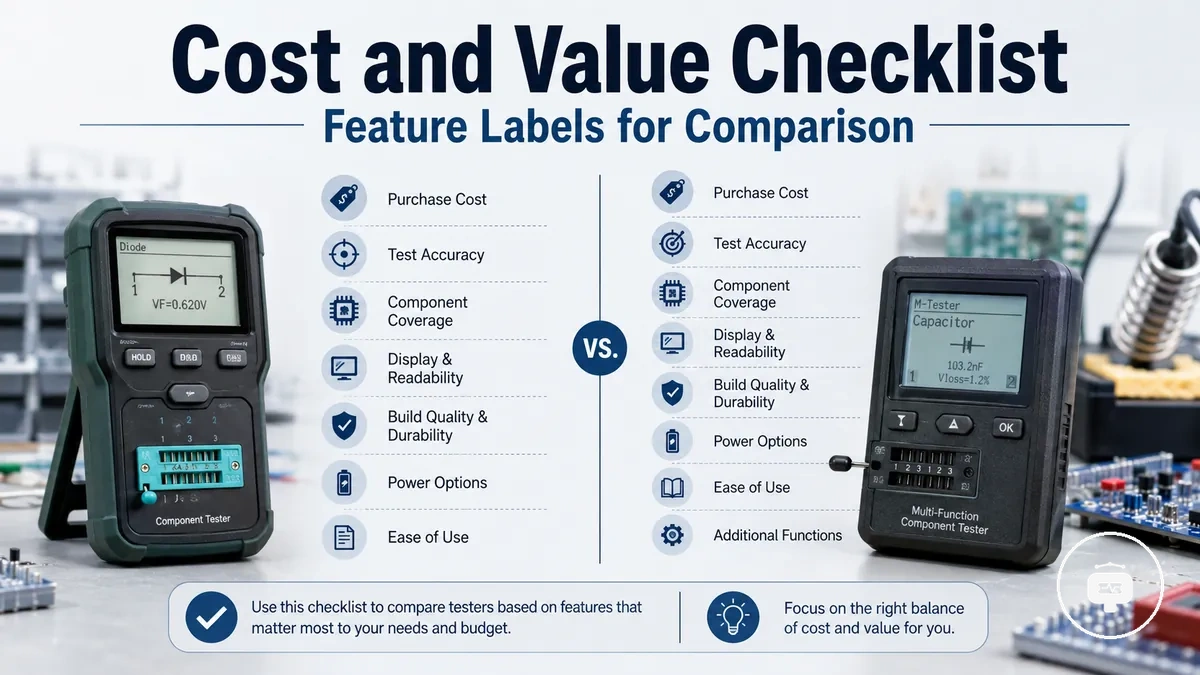
Electronic Component Tester Cost and Feature Value Checklist
An electronic component tester provides value when its cost matches the capabilities needed for the intended testing purpose. Price alone does not determine value because usefulness depends on the features that support specific testing needs and user requirements.
Evaluate an electronic component tester by balancing budget, features, and expected testing needs rather than focusing on cost alone. A budget component tester may provide suitable value when its capability aligns with the intended testing purpose, while broader feature sets can be more appropriate for users with wider evaluation requirements. The purchase decision should therefore be based on evaluation criteria that compare tester cost with practical capability and expected use. The first evaluation dimension is how cost relates to the features that provide meaningful value.
Electronic Component Tester Price Range and Value Factors
Electronic component tester price range reflects how component tester cost relates to capabilities, included equipment, and practical value for different testing needs. Price alone does not determine usefulness because value factors depend on how well the tester configuration and feature set match the intended application.
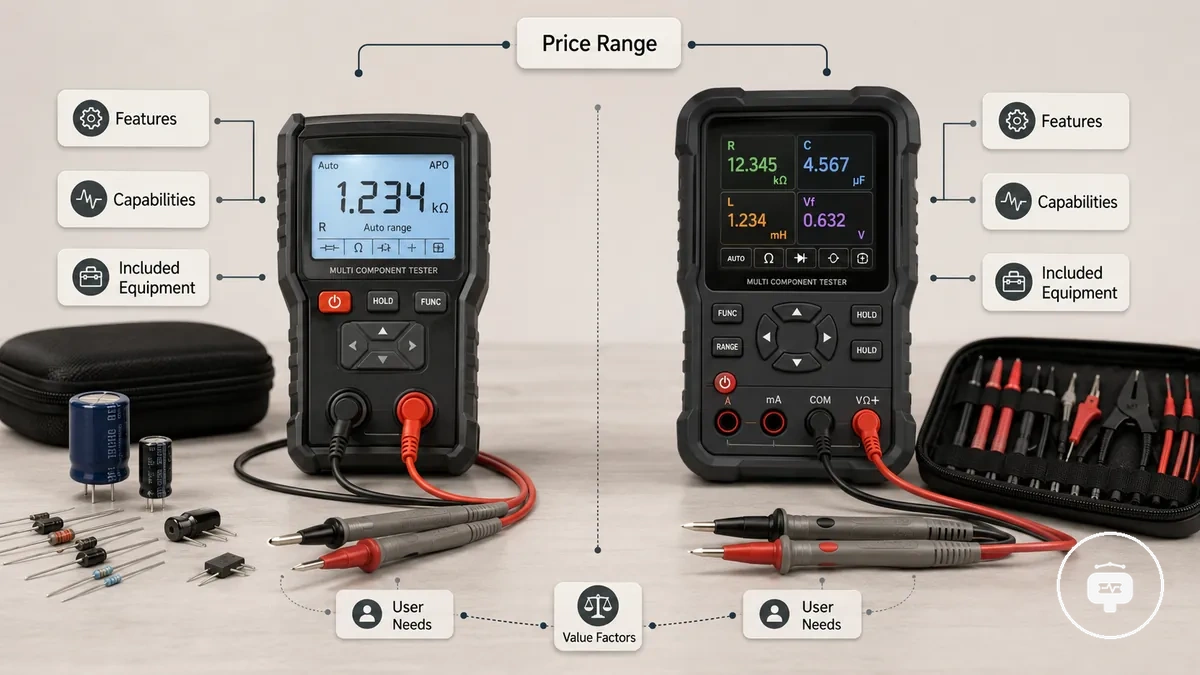
Component tester cost can vary with tester configuration, supported features, capabilities, display design, power options, and included equipment. Similar price ranges can deliver different value outcomes when each tester is designed for different usage needs. A model with essential features may provide suitable value for routine testing, while another at a comparable price may emphasize broader capabilities or additional accessories. The cost impact therefore depends on whether the included features support the intended testing purpose. If you are comparing evaluation factors before purchasing, it also helps to choose a tester based on expected usage rather than price alone.
The checklist below summarizes major value factors and their practical effects. Reviewing these evaluation factors helps interpret price range in relation to testing requirements instead of treating cost as the only decision criterion.
- Tester configuration: Different configurations may be better suited to different testing tasks.
- Feature set: Features add value when they support the required testing purpose.
- Capabilities: Broader measurement functions may justify higher component tester cost if they are regularly used.
- Included equipment: Relevant accessories can improve convenience and reduce the need for additional purchases.
- Price range: Similar price levels can represent different practical value depending on user requirements and usage needs.
What Determines Component Tester Cost
Component tester attributes determine cost by influencing measurement capability, usability, and the included hardware. No single attribute defines overall value because the importance of each feature depends on testing needs and the intended application. Evaluating these hardware factors together provides a more useful way to understand cost differences.
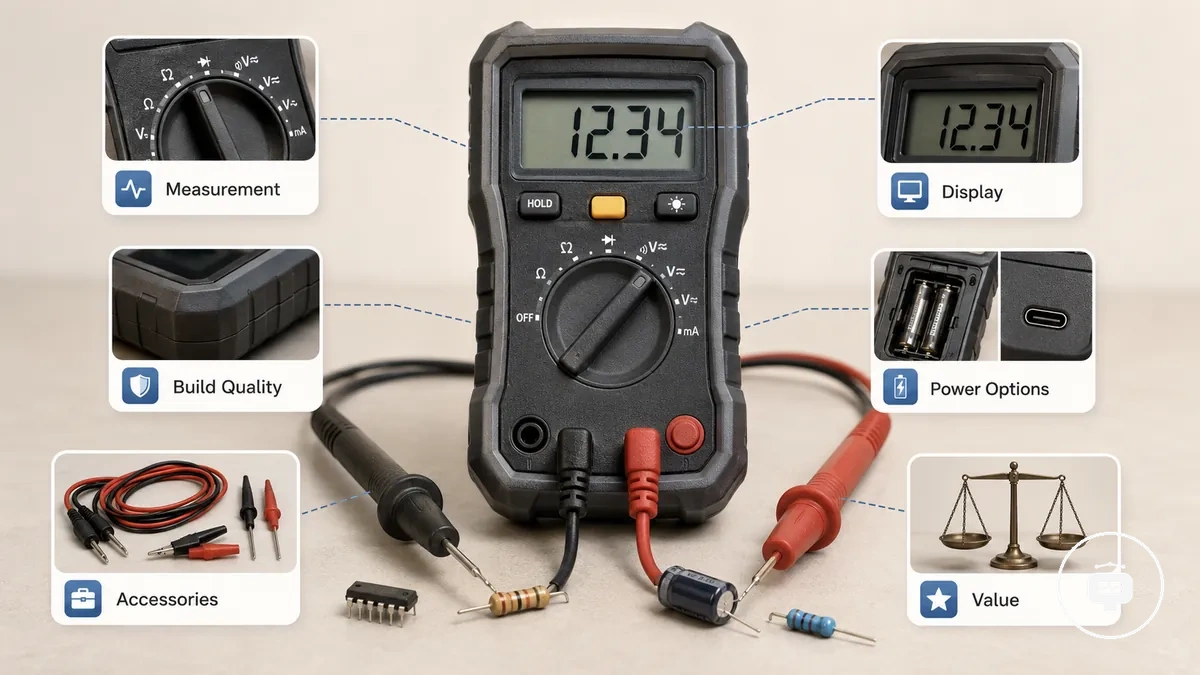
- Measurement capability: Broader measurement capability may increase cost when additional testing functions support the intended use.
- Build quality: Build quality can contribute to cost by affecting durability and practical usability during regular testing.
- Display: A clearer display may improve convenience and contribute to value when measurements need to be read quickly.
- Power options: Different power options can affect cost depending on operating flexibility and the planned testing environment.
- Accessories: Included accessories such as probes or adapters may increase cost while improving practical usefulness when they match regular testing tasks.
Considering these attributes together helps relate component tester cost to overall value rather than evaluating suitability by price alone.
Budget and Higher-Cost Component Tester Differences
Budget component tester and higher-cost tester differences depend on capabilities, included functions, and intended use rather than price alone. A comparison based on practical requirements provides a more useful evaluation because a simpler tester may be sufficient for routine tasks, while additional features can benefit broader testing needs.
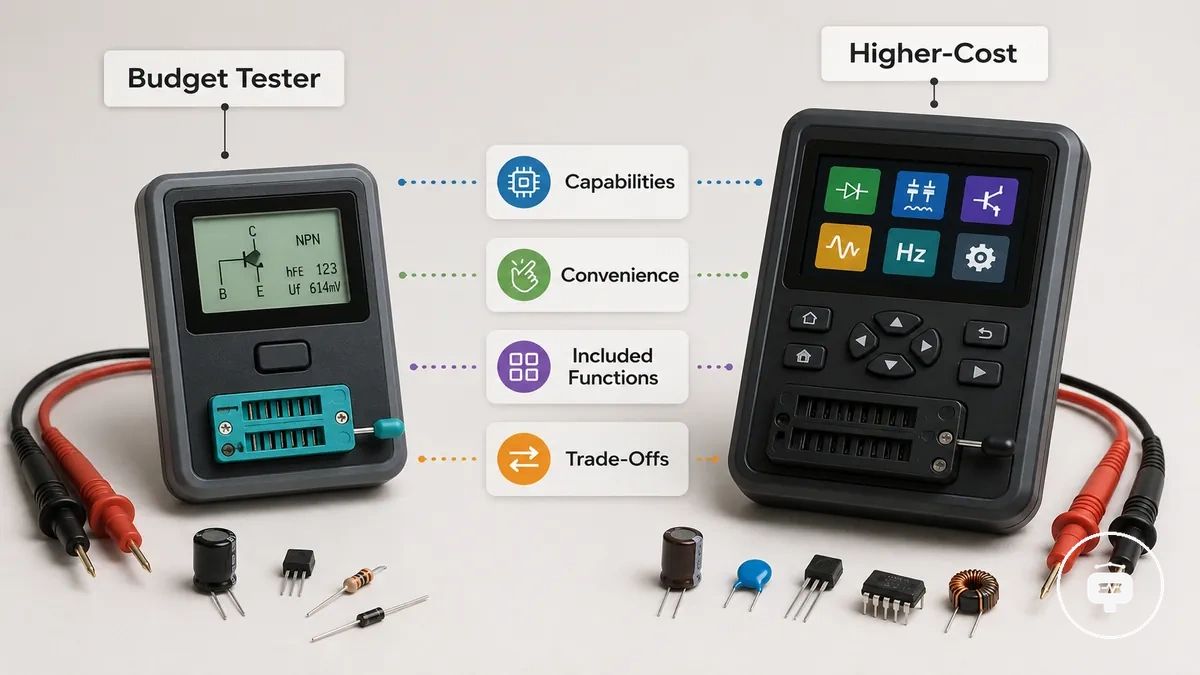
Comparison criteria include measurement capabilities, convenience, durability signals, and included functions. A budget component tester may provide the essential features needed for common component identification and basic measurements, although it may offer fewer convenience functions. A higher-cost tester may include added capabilities, expanded functions, or improved usability when those features support the intended application. The practical outcome depends on user requirements rather than price alone. When comparing options, it is also helpful to consider accuracy expectations because measurement requirements can influence which trade-offs are appropriate.
| Cost level | Features or capabilities | Practical advantage | Possible limitation |
|---|---|---|---|
| Budget component tester | Essential measurement capabilities and useful features | May provide sufficient value for routine testing tasks | May include fewer convenience functions or accessories |
| Higher-cost tester | Added capabilities, convenience features, and included functions | May support broader testing requirements and more flexible use | Additional features may offer limited practical value when they are rarely used |
The comparison shows that cost differences reflect feature selection and intended use instead of a fixed level of quality. Evaluating capabilities, convenience, and trade-offs against actual testing needs helps determine which tester offers the most practical value for a specific workflow.
Features Worth Paying For in an Electronic Component Tester
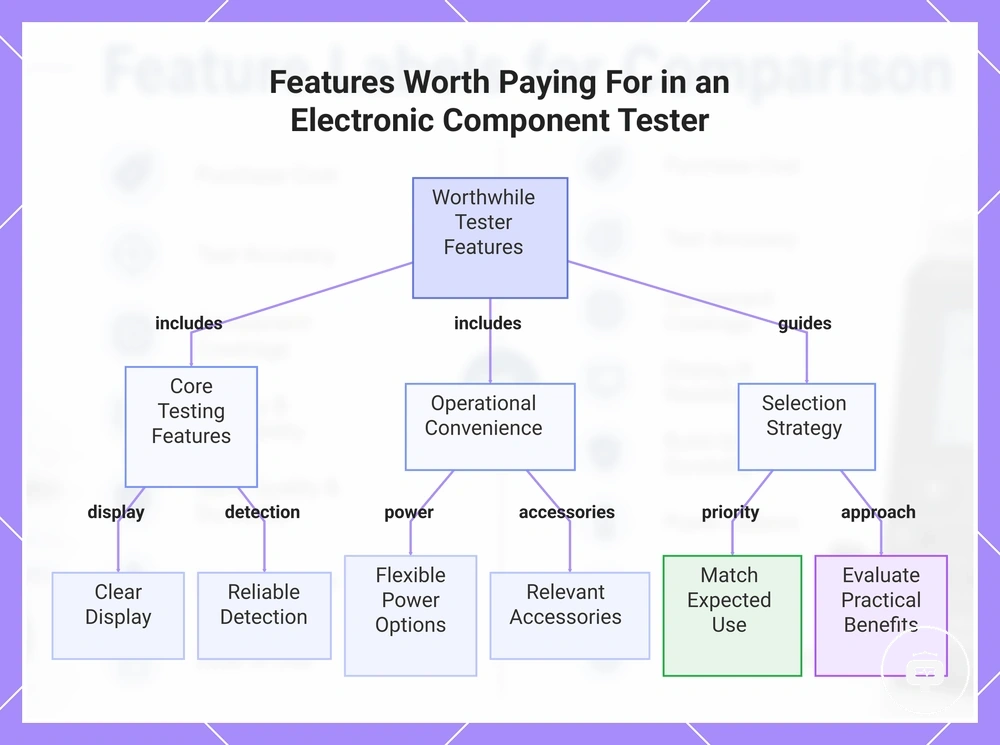
Useful features in an electronic component tester depend on testing goals rather than the number of functions included. Component tester features provide meaningful value when their capabilities improve routine testing tasks and support the intended workflow instead of adding functions that may rarely be used.
Useful features can be grouped by the practical benefits they provide. A clear display can improve readability and make measurement results easier to interpret. Reliable detection capabilities may improve testing efficiency by simplifying component identification. Flexible power options can add convenience in different working environments, while relevant accessories may extend practical use when they match regular testing tasks. For a broader explanation of features that matter, compare capabilities with expected testing needs rather than feature count alone.
The checklist below groups component tester features by their practical value. Features that directly support routine testing often have greater decision impact than low-priority additions that may provide limited benefit for many users.
- Display: Improved readability can make measurements easier to review and enhance everyday usability.
- Detection: Broader detection capability may improve testing efficiency by supporting faster component identification.
- Power: Flexible power options can provide added convenience across different testing environments.
- Accessories: Relevant accessories may increase practical value when they support regular testing tasks.
- Useful features: Prioritize capabilities that match expected use before paying for additional functions with limited practical value.
Cost-value decisions are more effective when component tester features are evaluated by their practical benefits rather than marketing terminology. Matching capabilities to testing requirements helps balance useful functions with overall value.
This chart groups useful component tester features by practical benefit and shows how to prioritize them for cost-effective decisions.
Display, Detection, Power, and Included Accessories
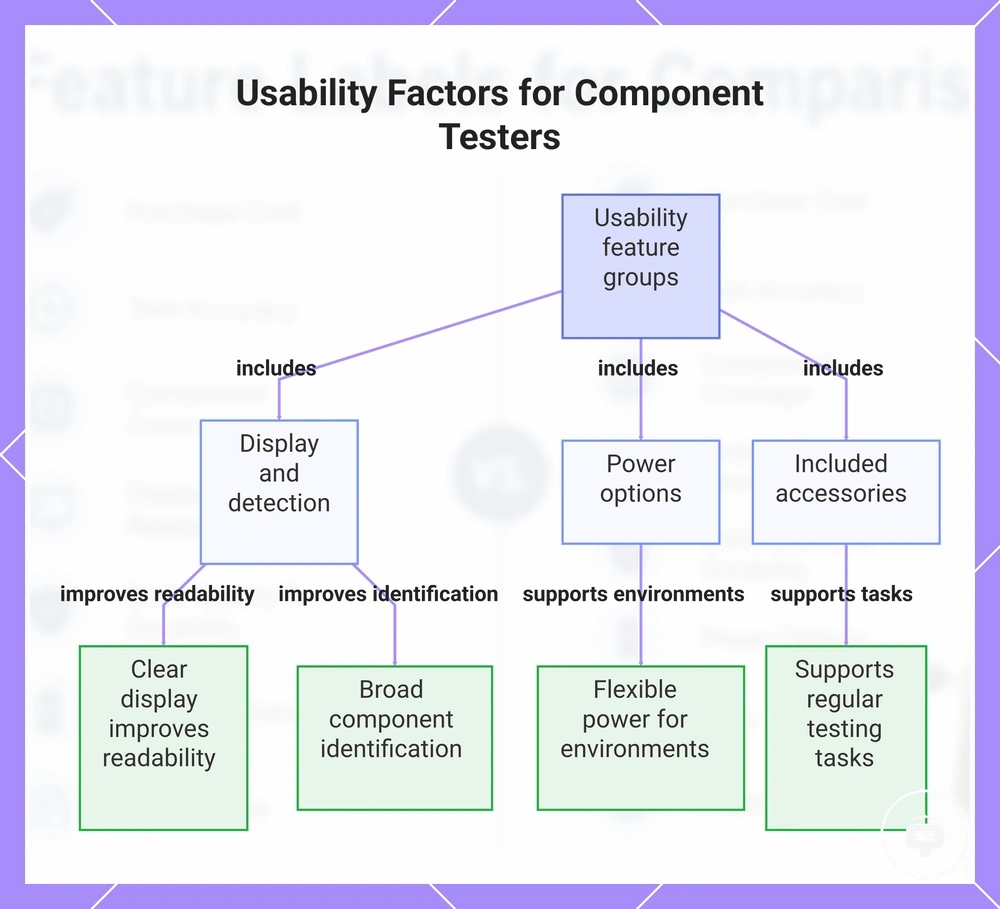
Display, detection, power options, and accessories affect usability by influencing how easily an electronic component tester can be operated in different testing situations. These feature groups support the overall testing experience together, and their practical value depends on user needs, testing context, and the intended application.
- Display: A clear display or interface can improve readability and support easier operation when reviewing measurement results.
- Detection: Detection capabilities may improve convenience by supporting broader component identification when required for the testing task.
- Power options: Flexible power options can influence usability by supporting different working environments and operating preferences.
- Accessories: Included accessories may increase practical value when they support regular testing tasks or reduce the need for additional tools.
These feature groups influence usability as a whole, and their value depends on how well they match the intended testing requirements rather than on any single attribute alone.
This chart shows the main feature groups that influence the usability of an electronic component tester and their specific benefits.
Component Tester Kit and Included Equipment Value
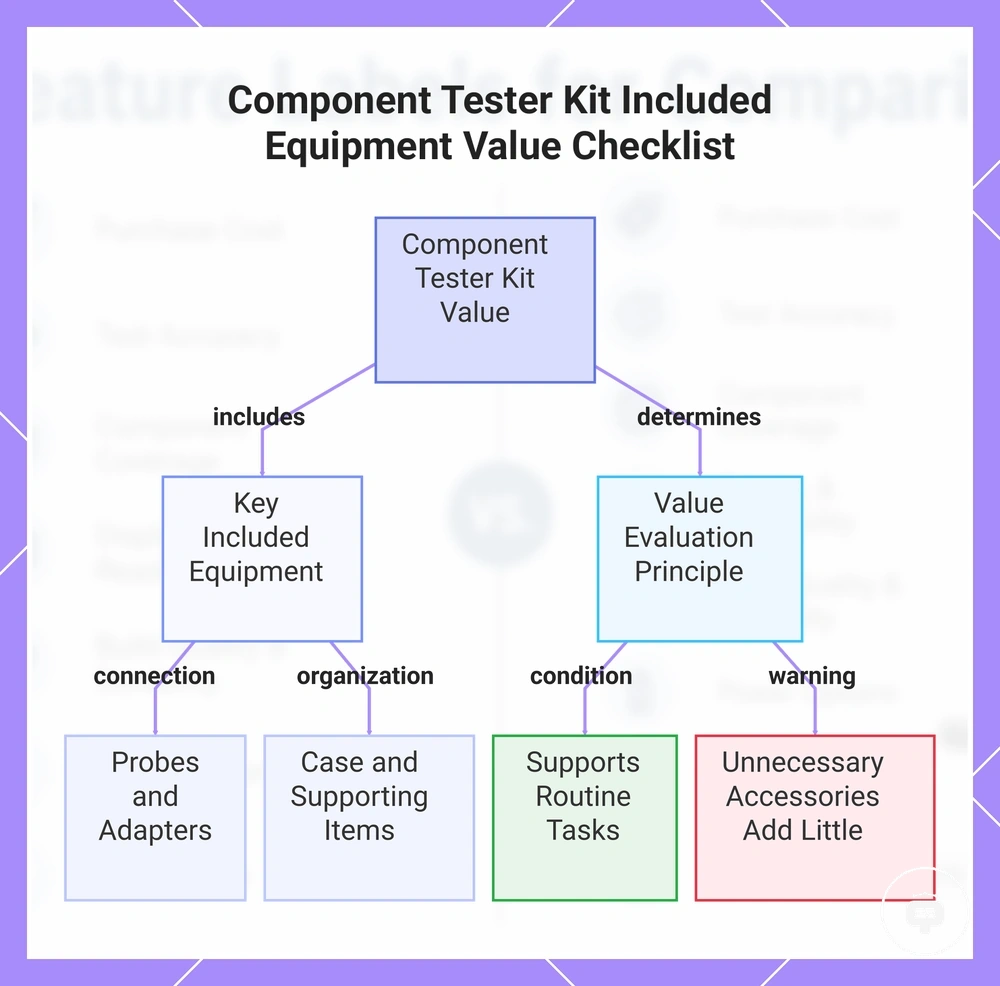
A component tester kit provides greater practical value when the included equipment supports the intended testing workflow rather than simply increasing the number of accessories. Useful probes, a protective case, adapters, and other supporting items can improve convenience, but their overall value depends on how they contribute to regular tester use. The checklist below highlights how included equipment can affect everyday practicality.
- Probes: Suitable probes can support reliable connection methods and improve convenience during routine component testing.
- Case: A protective case may improve portability and help keep the component tester kit and its included equipment organised between uses.
- Adapters: Included adapters can add practical value when they support the connection methods or components required for regular testing.
- Supporting items: Accessories such as storage or connection aids may improve usability when they match the intended testing workflow.
- Included equipment: Evaluate each included item by its practical use, because additional accessories do not necessarily increase overall value if they contribute little to the intended application.
Included equipment offers the greatest value when it supports routine testing tasks, while unnecessary accessories may add little practical benefit despite being included in the component tester kit.
This chart shows how included equipment in a component tester kit affects practical value, based on workflow support and usefulness of each accessory.
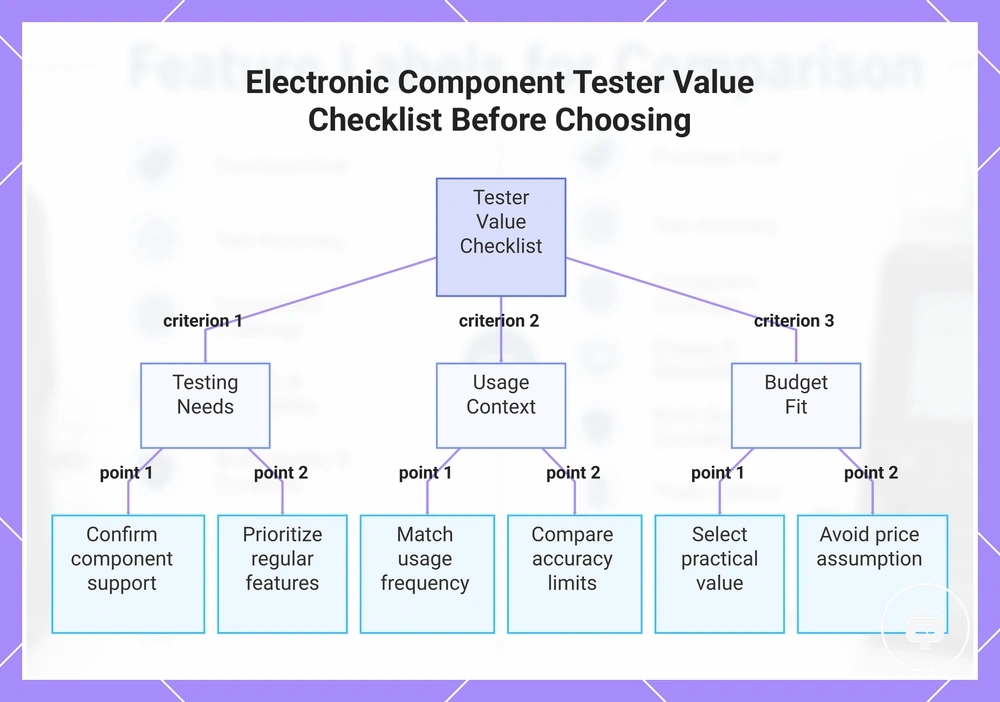
Electronic Component Tester Value Checklist Before Choosing
A value checklist helps verify whether an electronic component tester matches the testing requirements, expected usage, and budget before a purchase decision. It supports a consistent evaluation based on practical suitability rather than price or feature count alone.
The selection criteria should balance necessary features, accuracy expectations, expected usage, and budget alignment because suitability depends on the intended application. For first-time use, reviewing beginner tester choices can provide additional context for matching features to common testing needs. Use the checklist below to apply the same evaluation criteria across different testers.
- Testing requirements: Confirm that the tester supports the components and measurements needed for typical tasks before considering additional functions.
- Features: Prioritise features that support regular testing instead of functions that may offer limited practical value.
- Expected usage: Match the tester to how often and where it may be used, because different workflows can require different capabilities.
- Accuracy expectations: Compare measurement expectations with the tester's intended purpose and known limitations before deciding suitability.
- Budget alignment: Choose capabilities that provide practical value within the available budget rather than assuming that a higher price means better suitability.
This chart shows the key criteria and checklist points to evaluate an electronic component tester before purchase.
Matching Tester Features to Testing Needs
Matching tester features to testing needs helps identify which capabilities provide practical value for a particular use case. The most suitable feature set depends on user requirements, intended testing conditions, and the capability needed for routine tasks. The mini-checklist below maps common requirements to relevant features so suitability can be evaluated consistently.
- Requirement: Routine component testing → Feature: Essential measurement capability → Suitable condition: Regular everyday use → Expected benefit: May provide practical value without unnecessary functions.
- Requirement: Broader testing requirements → Feature: Expanded testing capability → Suitable condition: Different component types or wider use cases → Expected benefit: May support greater flexibility.
- Requirement: Frequent operation → Feature: Usability-focused features → Suitable condition: Repeated testing sessions → Expected benefit: Can improve convenience during regular use.
- Requirement: Higher accuracy expectations → Feature: Capability suited to measurement requirements → Suitable condition: When closer measurement confidence is needed → Expected benefit: May improve suitability for the intended testing conditions.
Match testing needs with the relevant features and capability before comparing additional functions, because suitability depends on the intended use and testing conditions.
When a Cheaper Component Tester Provides Enough Value
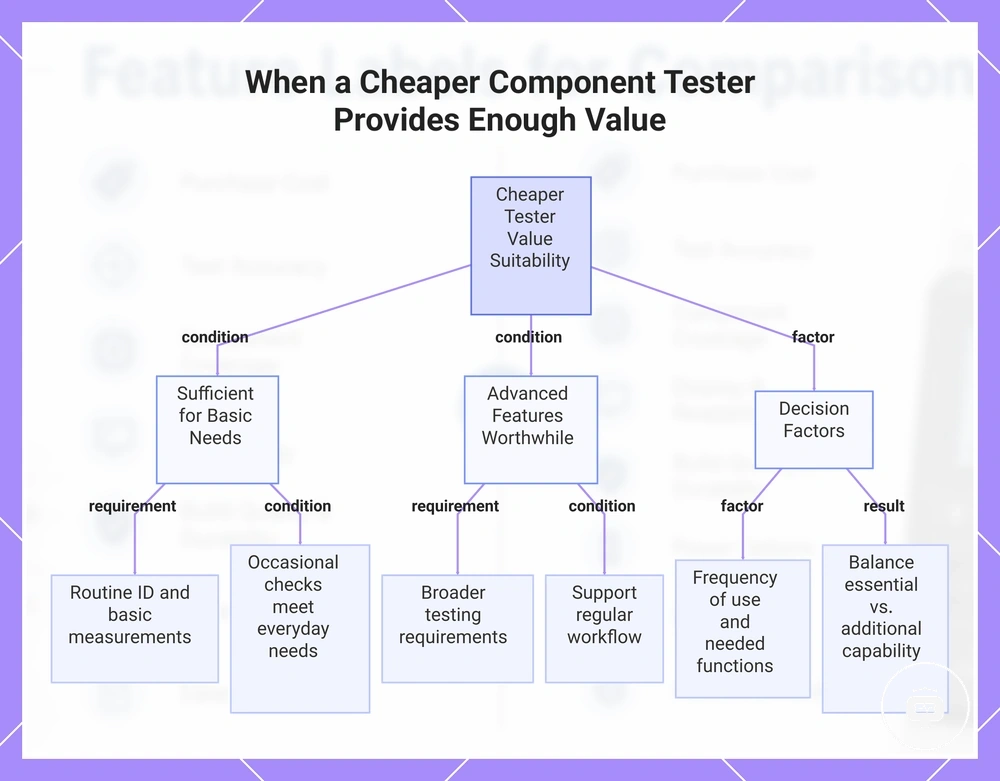
A cheaper component tester can provide sufficient value when its essential features satisfy the intended use and testing requirements. Suitability depends on whether the available capability supports the required tasks rather than on cost alone.
A lower-cost tester may be suitable when routine component identification and basic measurements are the primary requirements. A user performing occasional checks may find that essential features meet everyday testing needs without requiring additional functions. By contrast, users with broader testing requirements may benefit from extra capabilities when those features support their regular workflow. The trade-offs depend on how frequently the tester is used and which functions are genuinely needed. Unnecessary features may add cost without improving value when they are unlikely to be used.
The decision should balance the trade-offs between essential features and additional capability according to the intended use. A cheaper component tester may provide suitable value for straightforward testing tasks, while advanced features become worthwhile only when they improve suitability for the required testing conditions.
This chart shows the conditions under which a cheaper component tester provides sufficient value, balancing essential features and advanced capabilities based on intended use.