Using Electronic Component Testers to Identify and Sort Unknown Components
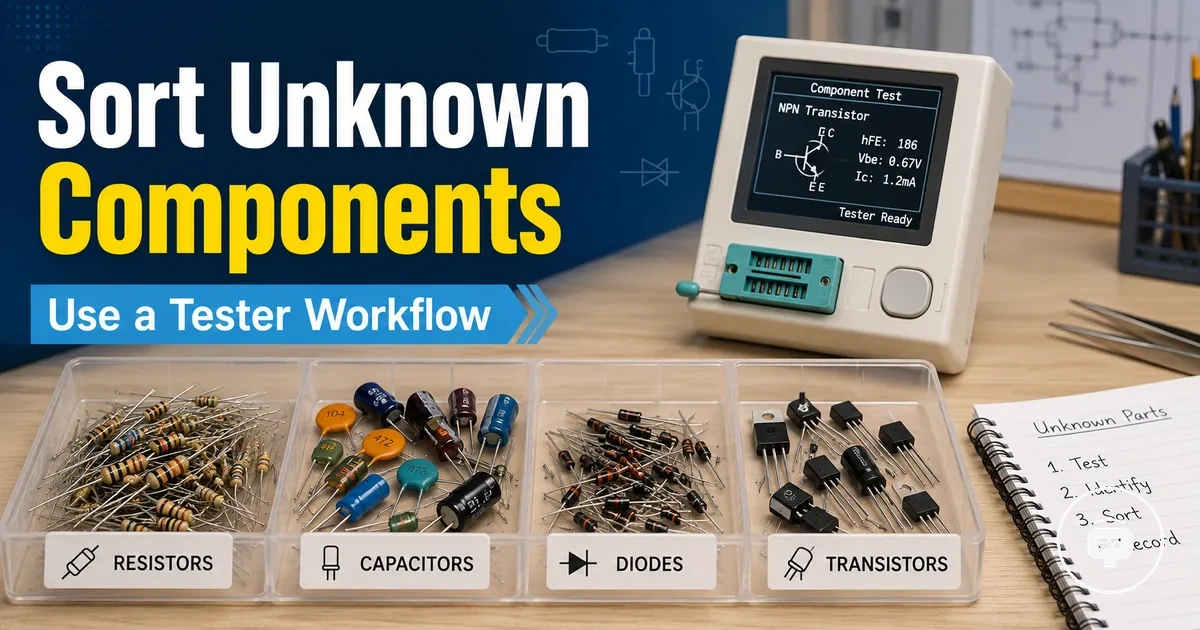
Using an electronic component tester to sort unknown components starts with connecting each part, reviewing the test readings, and grouping the part according to its detected type and measurements. The tester acts as a component identifier, but the identification may depend on the component condition, connection quality, tester capability, and testing context.
The sorting workflow links tester detection to a practical classification decision. An electronic component tester may identify a component category, measure relevant electrical values, and display results that help distinguish parts when the tester supports those categories.
Reliable sorting requires more than accepting a displayed label. The detected component type and measurements should be treated as evidence for classification, then checked for consistency before unknown components are organised into labelled groups. This creates a repeatable path from tester reading to classification without assuming that every part can be identified with complete certainty.
Unknown Component Identification with Electronic Component Testers
Electronic component testers identify unknown components by detecting the component type, displaying tester readings, and presenting measured values that help classify the identified component. The identification outcome may depend on the component's condition, the tester's capabilities, and how the component is connected during testing.
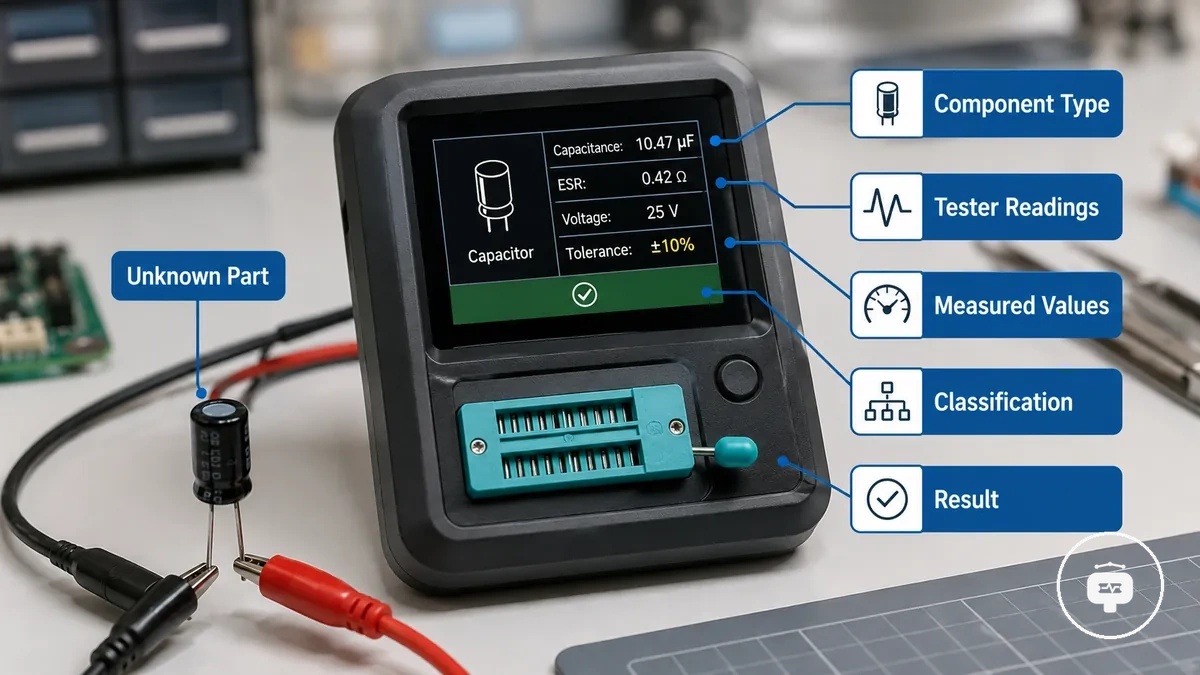
Component identification connects the detected part with tester-value results rather than a component name alone. Electronic component testers can identify a component type and present measured values that support interpretation and classification. For information about the range of detectable categories, see supported components.
Component identification should be viewed as the starting point rather than a complete technical analysis. When a component is damaged, uncommon, or outside a tester's capabilities, the displayed result may be incomplete or uncertain, so tester readings should be interpreted within those practical limits.
Preparing Unknown Components for Tester Identification
Preparing unknown components before testing helps electronic component testers produce clearer tester readings and more reliable identification results. Careful preparation, connection, and placement can improve reading quality, although the outcome may vary with the component and the tester.
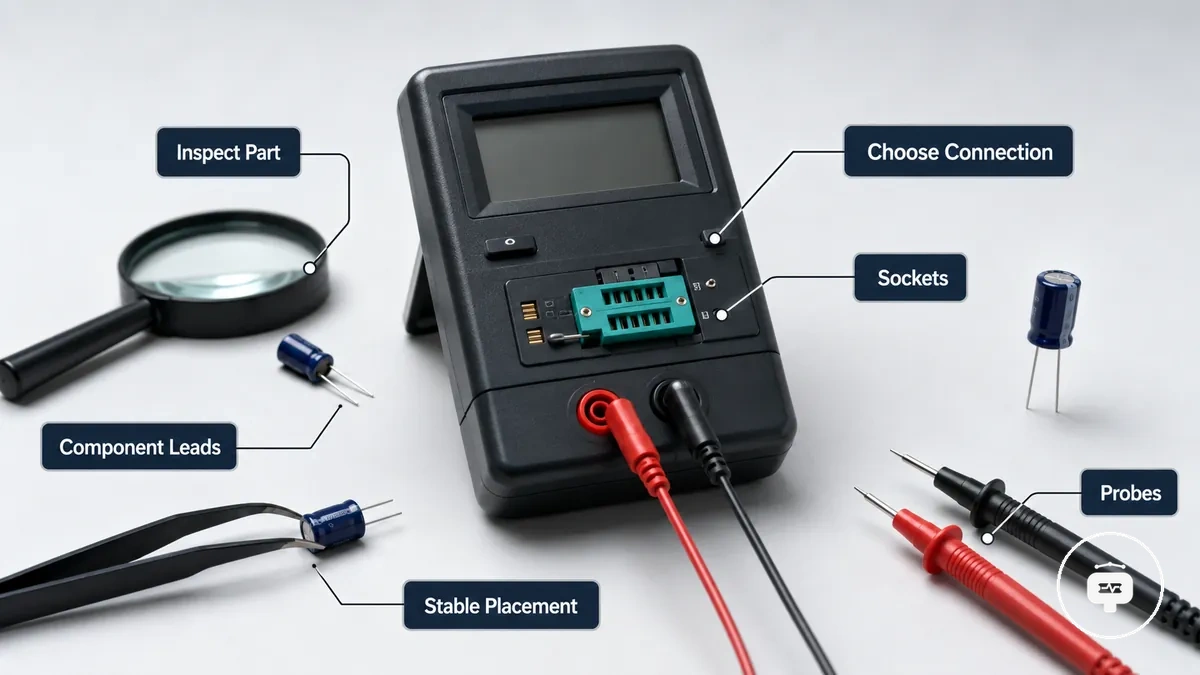
Follow this preparation sequence before starting identification:
- Inspect the unknown component for visible damage, contamination, bent component leads, or unclear markings that could affect preparation or connection.
- Choose the appropriate connection method. Position the component leads securely in the tester sockets or connect them with probes according to the test setup. If you need additional guidance on connection options, see probe and socket methods.
- Place the component so each lead has stable contact, then verify the connection before beginning identification. Stable placement can help improve setup-reading quality and reduce inconsistent tester readings.
- Confirm the preparation is complete before moving to identification. This preparation supports reliable tester readings while remaining separate from the broader testing workflow, where operation and measurement interpretation are covered.
Testing Components to Determine Type and Electrical Values
Electronic component testers measure electrical characteristics to help identify an unknown component. Resistance, capacitance, transistor detection, and other readings provide evidence for classification, although the interpretation depends on the component's condition, the measured values, and the tester's capabilities.
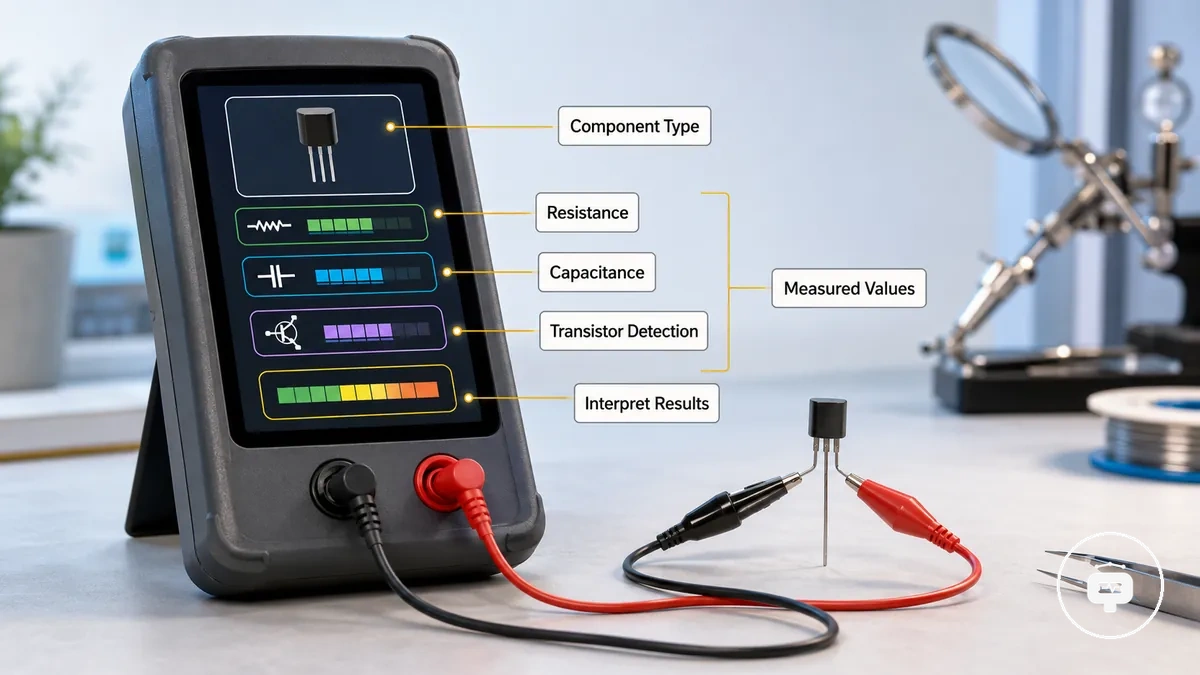
Each measurement represents an electrical attribute rather than a guaranteed identification. Interpreting component-attribute-value relationships helps determine whether the test results are consistent with a particular component type. Learning how to read component values can improve reading interpretation before making a classification decision.
The following measurement attributes commonly support component identification:
| Measurement Attribute | Identification Relevance |
|---|---|
| Resistance | Provides a measured value that can be compared with the expected characteristics of a resistive component. |
| Capacitance | Indicates the component's electrical storage characteristic and contributes to identification. |
| Transistor detection | May indicate transistor behaviour and provide additional readings that support classification. |
| Measured values | Combine with the detected component type to provide evidence for interpretation rather than a fixed identification. |
Reading interpretation should consider multiple measurements together instead of relying on a single value. Comparing readings and values as a group provides stronger evidence for component classification while recognising that test results can vary with component condition and tester limitations.
Sorting Resistors, Capacitors, Transistors, and Other Detected Components
When identification results are available, each detected component can be classified into a practical component group before storage or further use. For example, if a tester identifies a resistor, capacitor, or transistor and the readings support that result, the part can be sorted into the corresponding classification category, while uncertain results may be set aside for additional verification.
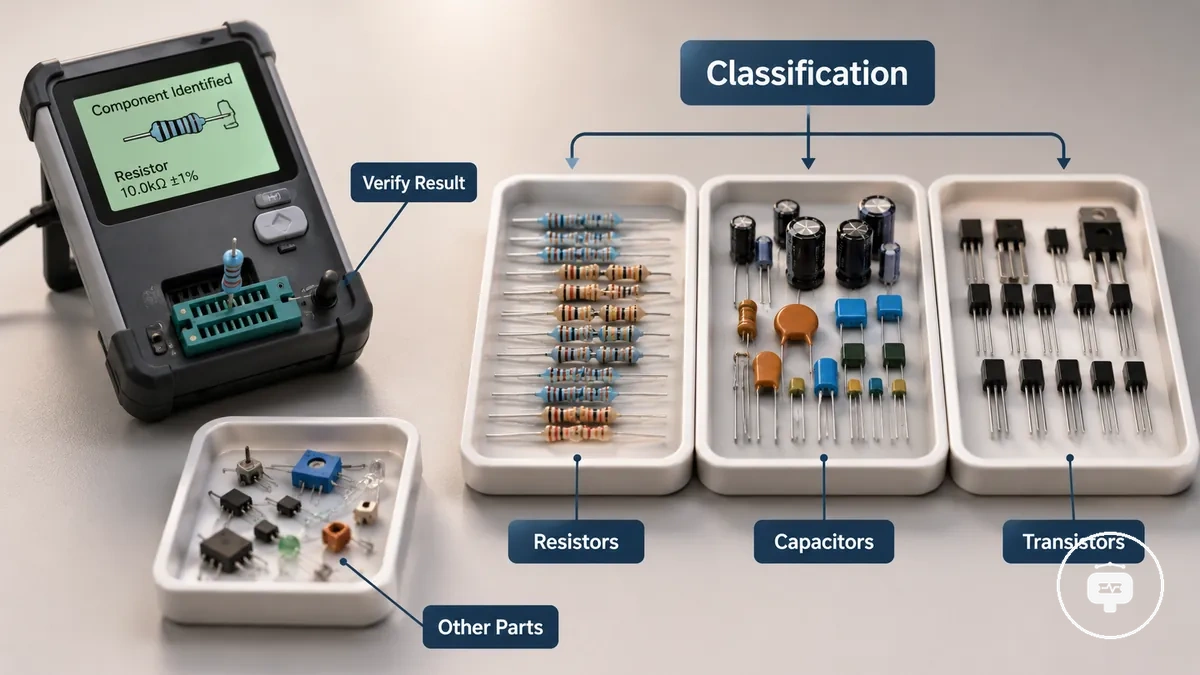
Examples of practical classification decisions include:
- Resistor: Classify as the resistor component group when the measured characteristics are consistent with a resistive component.
- Capacitor: Sort into the capacitor component group when the detected characteristics support capacitor classification.
- Transistor: Group with transistor components when transistor detection and related readings support that part category.
- Other detected components: Place into a separate component group when another supported part category is identified or when further verification may be appropriate before final classification.
These examples illustrate how identification results can be organised into clear sorting categories while keeping the focus on practical classification rather than creating a complete component reference.
Recording Tester Results for Component Classification
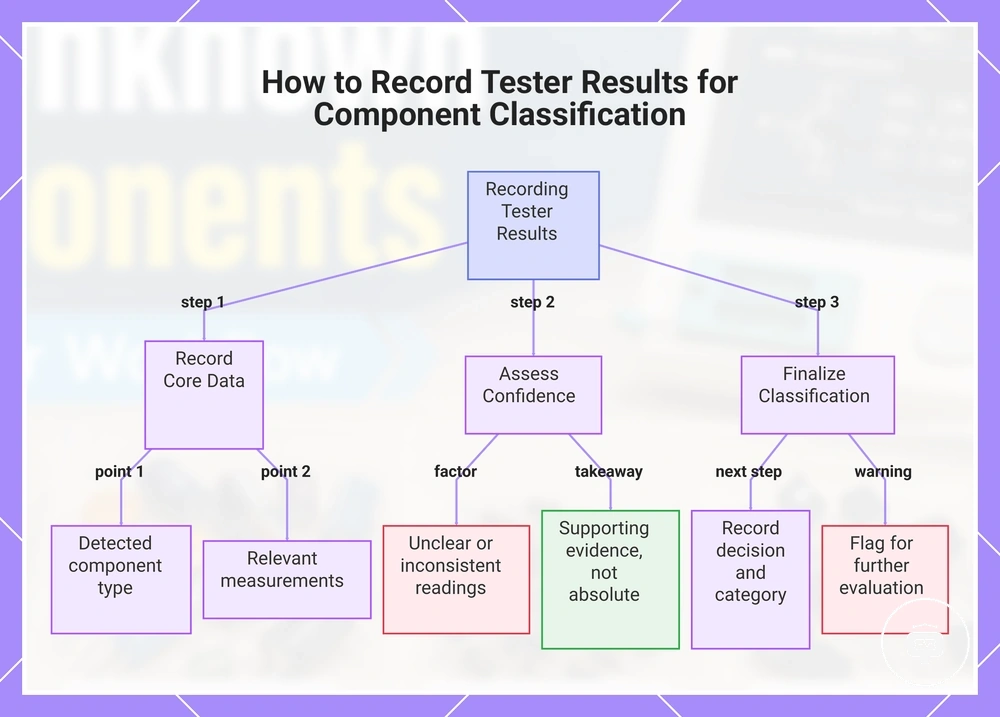
Recording tester results supports consistent component classification by organising recorded results, measurements, confidence notes, and classification decisions before components are sorted. A structured sorting record provides evidence for later evaluation while recognising that classification confidence can vary with the component, the measurements, and the tester.
Use a consistent checklist to organise recorded results before assigning a component to a sorting category:
- Record the detected component type reported by the tester.
- Record the relevant measurements and displayed values that support the classification.
- Add notes about factors that may affect confidence, such as unclear readings or inconsistent test results.
- Record the classification decision and the selected sorting category.
- Flag components for further evaluation when the recorded results do not provide sufficient confidence for final classification.
For example, a sorting record can include the detected type, recorded measurements, confidence notes, and the resulting classification decision. Organising recorded results in a consistent format helps support later sorting choices while treating the information as supporting evidence rather than absolute confirmation.
This chart shows the step-by-step process for recording tester results to support consistent component classification, including data recording, confidence assessment, and final classification decisions.
Limits of Automatic Component Identification
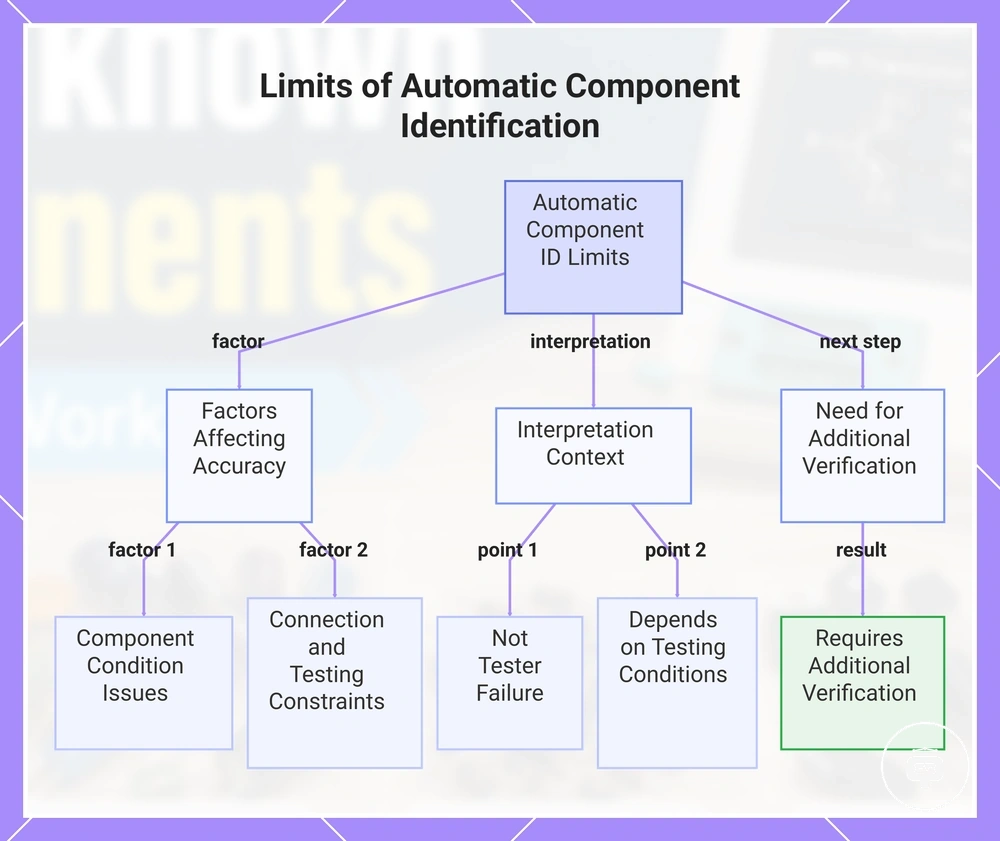
Automatic component identification has limitations because component condition, testing constraints, and connection quality can affect the detected result and lead to uncertainty. Incorrect readings do not necessarily indicate tester failure, as the interpretation may depend on the component being tested and the testing conditions.
The following factors can influence identification accuracy and interpretation:
- Damaged or degraded component condition may affect detection and contribute to incorrect readings or uncertain identification.
- Unusual or unsupported components may not be identified completely, creating a detection issue that requires cautious interpretation.
- Connection issues, such as unstable lead contact, can affect measurements and influence the resulting classification.
- Testing constraints or measurement limitations may reduce confidence when the available readings do not clearly support a single component category.
These limitations should be interpreted as part of the testing process rather than as proof of tester failure. Automatic component identification can support classification, but uncertain readings, component condition, and testing constraints may require additional verification before reaching a final interpretation.
This chart shows the main factors that limit automatic component identification, how to interpret them, and the need for additional verification.