
Raspberry Pi Accessories Cost and Value
Raspberry Pi accessories deliver the best value when their cost matches the requirements of a specific project rather than simply being the lowest-priced option. Accessory value is determined by five primary criteria: compatibility with the Raspberry Pi model, reliability during operation, usefulness for the intended workload, expected service life, and purchase cost. According to Raspberry Pi documentation, accessory compatibility must match the board generation because power connectors, interfaces, and supported hardware features differ between Raspberry Pi models.
Accessory cost alone does not indicate value.
Accessory cost alone does not indicate value. The retained section evidence indicates that Raspberry Pi accessories span a broad price range, from approximately US$4.60 for simple expansion modules to around US$97 for larger touchscreen displays, showing that price primarily reflects hardware capability and complexity rather than universal quality. A practical comparison is that a low-cost GPIO expansion board can provide complete value for a sensor project, while the same accessory adds little value to a desktop media-centre build because it does not contribute to that workload. This price range is supported by the retained section evidence used for this article.
This price range is supported by the retained section evidence used for this article.
For this reason, Raspberry Pi accessories should be evaluated as part of a complete setup instead of as isolated purchases. Compatibility ensures the accessory functions with the selected Raspberry Pi model, reliability influences long-term operation, usefulness determines whether the accessory contributes to the intended task, and cost should be considered only after those requirements are satisfied. The following sections examine each of these decision factors in greater detail so worthwhile spending can be assessed without relying on price alone.
Table of Contents
Understanding the Cost Factors Behind Raspberry Pi Accessories
Raspberry Pi accessories differ in accessory cost because their function, included components, compatibility, manufacturing quality, and intended workload differ. An accessory that performs a specialised task, supports more Raspberry Pi models, or includes additional hardware generally represents a higher production cost, while its practical value depends on whether those features are required for the intended setup rather than on price alone.
Cost drivers become clearer when Raspberry Pi accessories are compared by their technical role instead of their selling price.
Cost drivers become clearer when Raspberry Pi accessories are compared by their technical role instead of their selling price. The Raspberry Pi accessories hub provides a broader overview of these categories and how they fit into complete Raspberry Pi systems.

For example, a case manufactured from aluminium with integrated cooling contains more materials and manufacturing steps than a basic plastic enclosure, while a starter kit that bundles five accessories provides different value from purchasing only the two components needed for a project. These examples illustrate that included components, compatibility coverage, and functional capability influence accessory cost, whereas the practical value increases only when those additional features contribute to the intended Raspberry Pi application.
Evaluating Raspberry Pi accessories therefore begins by identifying the cost drivers rather than comparing prices.
Evaluating Raspberry Pi accessories therefore begins by identifying the cost drivers rather than comparing prices. Function, compatibility, included components, and build quality explain why accessories differ in cost, while their overall value is determined by how effectively those characteristics support a specific Raspberry Pi configuration without paying for unnecessary features.
Raspberry Pi Accessory Features That Determine Long-Term Value
Raspberry Pi accessory features determine long-term value by improving reliability, maintaining compatibility, supporting the intended workload, and reducing unnecessary replacement over time. The most valuable accessory attributes are reliability, build quality, compatibility, durability, cooling, and power, because each affects ownership decisions differently depending on how the Raspberry Pi is used. According to Raspberry Pi documentation, using compatible accessories and an appropriate power supply helps maintain stable operation and reduces avoidable hardware issues.
According to Raspberry Pi documentation, using compatible accessories and an appropriate power supply helps maintain stable operation and reduces avoidable hardware issues.
The most useful way to evaluate accessory features is to connect each attribute to its effect on long-term ownership:
- Reliability: Accessories that consistently perform their intended function reduce interruption risk during continuous operation. For example, selecting reliable power accessories is more important for a Raspberry Pi running 24 hours a day than for a board used only occasionally.
- Build quality: Better construction materials and manufacturing quality improve resistance to repeated handling, although actual service life depends on environmental conditions and usage rather than a guaranteed lifespan.
- Compatibility: Connectors, interfaces, mounting points, dimensions, and supported Raspberry Pi models should match the intended hardware configuration before purchase.
- Cooling: The cooling accessories value increases for workloads that generate sustained processor heat because suitable cooling can help maintain consistent operating performance by reducing thermal throttling.
- Included functionality: Accessories that combine multiple useful functions can reduce the number of separate components required when every included feature contributes to the planned project.
The relationship between these attributes is easier to understand when viewed together.
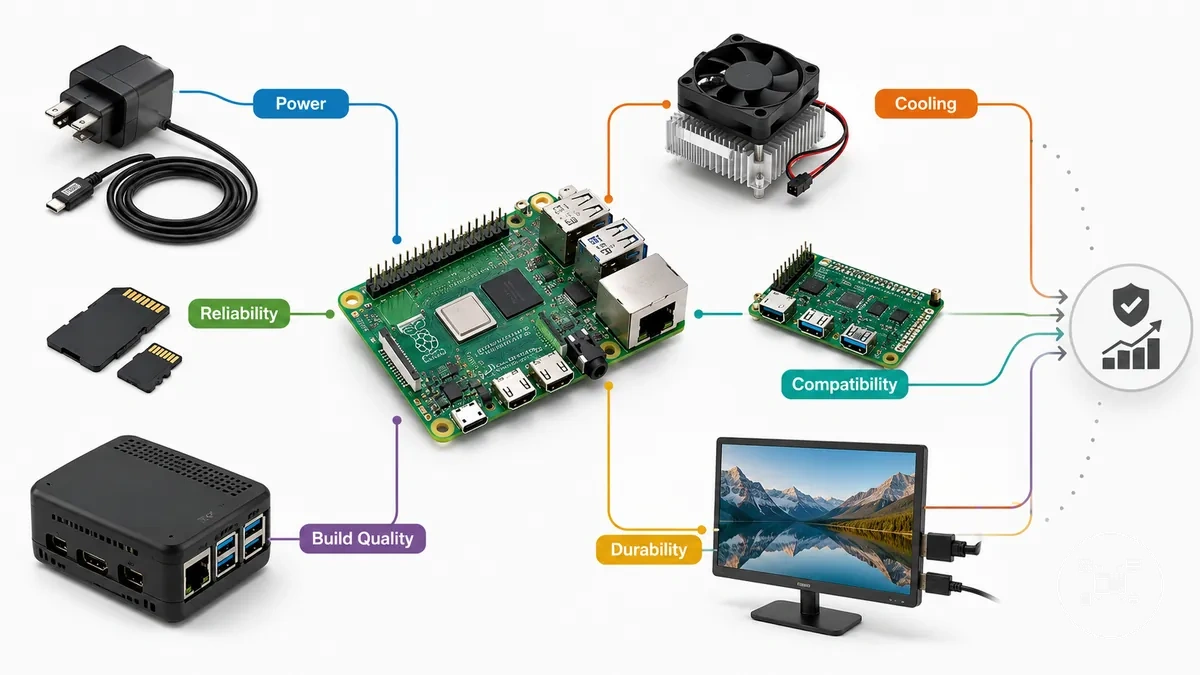
For example, a Raspberry Pi used as a home automation controller operating continuously places greater value on dependable power delivery and effective cooling than on cosmetic enclosure features, while a classroom Raspberry Pi transported between lessons benefits more from durable construction and broad peripheral compatibility. These scenarios demonstrate that the importance of each accessory feature changes with the operating environment and intended workload, so long-term value comes from matching accessory attributes to project requirements rather than selecting features that provide little practical benefit.
Choosing Raspberry Pi Accessories Based on Use Case and Budget
Raspberry Pi accessories should be selected by matching the use case, budget, compatibility, and project requirements instead of purchasing the largest accessory bundle. According to the Raspberry Pi Foundation, accessories must be compatible with the Raspberry Pi model because connectors, power requirements, and supported interfaces differ between board generations. The most cost-effective selection is therefore the one in which every accessory performs a required function and unnecessary components are excluded.
The most cost-effective selection is therefore the one in which every accessory performs a required function and unnecessary components are excluded.
Use the following selection criteria to evaluate accessories before spending:
- Required function: Select only accessories that directly support the intended use case, such as programming, media playback, robotics, or home automation.
- Compatibility: Verify the Raspberry Pi generation, connector type, interface support, mounting dimensions, and power requirements before purchase.
- Expected workload: Continuous 24-hour operation generally justifies spending on reliable power delivery and appropriate cooling, while occasional educational or hobby projects typically require fewer supporting accessories.
- Budget priorities: Allocate the budget to essential functions before optional upgrades so spending reflects project requirements rather than accessory quantity.
- Foundational setup: Begin with an essential accessories checklist to confirm that required components are included before evaluating convenience or expansion accessories.
For example, suppose a Raspberry Pi project has an accessory budget of AU$100. Spending AU$70 on a compatible power supply, storage, and protective case leaves AU$30 for project-specific hardware only if those additional accessories contribute to the intended workload. By contrast, using the same budget on unused expansion boards reduces overall value because the additional cost does not improve the project's functional outcome.
For example, suppose a Raspberry Pi project has an accessory budget of AU$100.
This chart shows the three main selection criteria for Raspberry Pi accessories: matching to use case, verifying compatibility and workload, and prioritizing budget on essentials.

When Raspberry Pi Accessory Kits and Bundles Offer Better Value
Raspberry Pi accessory bundles provide better value than purchasing individual accessories only when the kit includes components that are all required, compatible with the intended Raspberry Pi model, and reduce the need for separate purchases. According to Raspberry Pi documentation, compatibility remains a model-specific requirement because power connectors, interfaces, and supported hardware differ between Raspberry Pi generations. Bundle value therefore depends on included components, compatibility, convenience, and avoided duplicate purchases rather than on the number of accessories alone.
The comparison below highlights the main bundle trade-offs without assuming that either option is universally better.
The comparison below highlights the main bundle trade-offs without assuming that either option is universally better.
| Comparison attribute | Accessory bundle or kit | Individual accessories |
|---|---|---|
| Included components | Provides a predefined collection of accessories intended to work together. | Only the required accessories are purchased. |
| Compatibility control | Convenient when all bundled components match the intended Raspberry Pi model. | Each accessory can be selected and verified individually. |
| Flexibility | Limited to the accessories included in the kit. | Maximum flexibility for specialised or upgraded configurations. |
| Value outcome | Highest when nearly every bundled component will be used. | Highest when existing accessories can be reused or unnecessary components can be avoided. |
For example, suppose a kit contains six compatible accessories and a project requires five of them. Purchasing the bundle leaves only one unused component, whereas buying six separate accessories would require six individual purchasing decisions. Conversely, if the same project requires only two of the six bundled items, purchasing those two individual accessories avoids paying for four unused components. The related accessory kit value comparison explains these bundle-specific trade-offs in greater detail.
For example, suppose a kit contains six compatible accessories and a project requires five of them.
Bundle selection is therefore preferable when included components closely match project requirements and simplify setup, while separate accessories are preferable when compatibility needs are specialised, existing hardware can be reused, or unused bundled components would reduce overall value. The decision should compare required components against included components instead of assuming that larger kits automatically provide better value.
Raspberry Pi Accessories That Are Worth Paying More For
Raspberry Pi accessories are worth paying more for when the added premium value delivers a required improvement in reliability, risk reduction, physical fit, or long-term use. Higher spending is justified only when the accessory reduces a specific power, protection, cooling, or storage risk that a less expensive compatible option does not address.
Higher spending is justified only when the accessory reduces a specific power, protection, cooling, or storage risk that a less expensive compatible option does not address.
Evaluate the cost-benefit trade-off through these criteria:
- Power stability: Additional spending is justified when the accessory matches the Raspberry Pi model’s required connector, voltage, current capacity, and cable configuration, reducing the risk of unstable operation.
- Protection and fit: A higher-cost enclosure adds value when its dimensions, mounting points, ventilation, and port openings match the complete setup and protect the board in the intended environment.
- Cooling requirements: A more capable cooling accessory supports long-term use when sustained processor activity creates enough heat to affect operating performance and the enclosure allows the cooling method to function correctly.
- Storage reliability: Paying more is justified when the storage device provides the required capacity, interface compatibility, and workload suitability for frequent writes or continuous operation.
- Reliability evidence: Compare documented compatibility, construction, operating conditions, and support information when assessing reliable Raspberry Pi accessories, rather than treating price as a reliability rating.
For example, suppose two compatible accessory sets cost an illustrative AU$60 and AU$100. The additional AU$40 creates meaningful value when the higher-cost set adds required cooling, complete port access, and suitable storage for a system operating continuously; it creates limited value when those features remain unused in an occasional classroom project. Higher-value features therefore justify extra spending only when they reduce a defined risk or support a required function that the less expensive option does not provide.
For example, suppose two compatible accessory sets cost an illustrative AU$60 and AU$100.
This chart shows the criteria that justify paying more for Raspberry Pi accessories, focusing on power, protection, cooling, storage, and reliability evidence.

Avoiding Poor-Value Raspberry Pi Accessories
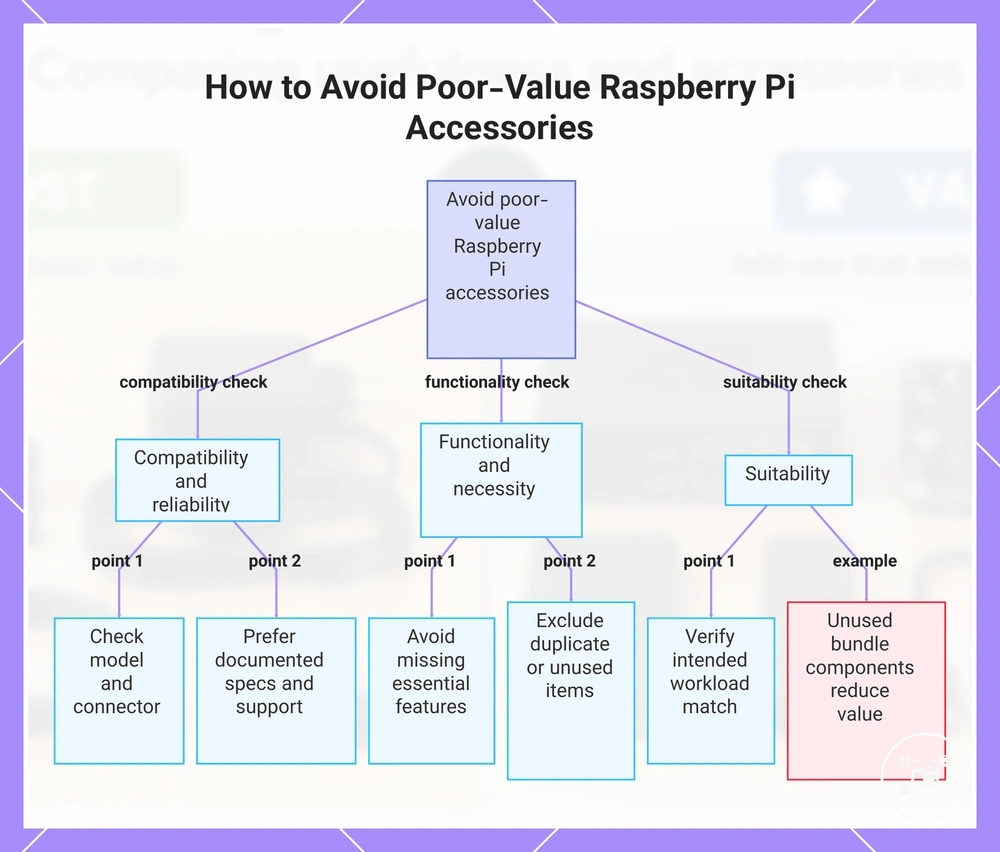
Poor-value Raspberry Pi accessories are products whose value is reduced by a compatibility risk, missing functionality, unreliable construction, or an unnecessary purchase relative to the intended use case. According to Raspberry Pi documentation, accessories should be selected for the specific Raspberry Pi model because connectors, interfaces, and power requirements differ between generations. A low purchase price alone does not determine suitability if the accessory cannot perform its required function.
A low purchase price alone does not determine suitability if the accessory cannot perform its required function.
Use the following checklist before purchasing:
- Compatibility risk: Confirm that the accessory supports the correct Raspberry Pi model, connector type, physical dimensions, and interface before purchase.
- Required functionality: Avoid accessories that omit features essential for the planned project because additional purchases increase the overall cost without increasing value.
- Reliability: Prefer accessories with documented compatibility, operating specifications, and manufacturer support instead of products with incomplete technical information.
- Unnecessary purchase: Exclude accessories that duplicate hardware already owned or provide functions the project will not use.
- Suitability: Verify that the accessory is designed for the intended workload, such as continuous operation, portable use, or educational projects, rather than assuming one accessory suits every application.
An accessory that is unsuitable for one project is not necessarily a poor-quality product; it becomes a poor-value purchase only when its attributes do not match the required application. For example, suppose a project requires three accessories but a six-piece bundle includes three additional components that remain unused. In that scenario, half of the bundle's contents provide no functional value, whereas the same bundle could represent good value for another project that uses all six components.
For example, suppose a project requires three accessories but a six-piece bundle includes three additional components that remain unused.
This chart outlines the main checks to avoid poor-value Raspberry Pi accessories, including compatibility, functionality, and suitability checks, and illustrates a common poor-value scenario.