Raspberry Pi Power Accessories: Supplies, Cables, and Stable Power
Raspberry Pi power accessories are the components that provide electrical power to a Raspberry Pi board, including the power supply, power cable, and matching connector. Their role is to deliver stable power at the voltage, current, and connector type required by the specific Raspberry Pi model so the board can operate reliably. According to Raspberry Pi Ltd., the required power specification depends on the board model and the connected hardware rather than on a single universal power accessory.
Their role is to deliver stable power at the voltage, current, and connector type required by the specific Raspberry Pi model so the board can operate reliably.
Raspberry Pi power accessories should be evaluated by their ability to provide stable power delivery, maintain connector compatibility, and satisfy the power requirements of the intended board and attached peripherals. Raspberry Pi Ltd. specifies that the official Raspberry Pi 4 USB-C power supply provides 5.1 V DC at up to 3.0 A (15.3 W), while the official Raspberry Pi 5 USB-C power supply provides 5.1 V DC at up to 5.0 A (25.5 W) when paired with a suitable 5 A-rated cable. For example, according to Raspberry Pi Ltd., a Raspberry Pi 5 operating with multiple USB peripherals can draw more current than earlier models, so using a power supply and power cable rated for the required output helps maintain stable operation and reduces the likelihood of undervoltage events. These electrical specifications, together with connector type, cable capability, board compatibility, and connected hardware, form the primary criteria for evaluating Raspberry Pi power accessories.
Table of Contents
Raspberry Pi Power Accessories and Stable Power Delivery
Raspberry Pi power accessories are components that provide and maintain electrical power for a Raspberry Pi board, including a power supply, cable, and compatible power connector. Their primary role is to deliver stable power delivery that matches the electrical requirements of a specific Raspberry Pi model rather than serving as interchangeable components. According to Raspberry Pi Ltd., official power accessories are specified for particular board generations, with output voltage, maximum current, and connector type defined for each supported model.
These model-specific specifications show that accessory suitability depends on the Raspberry Pi board's power requirements rather than on universal compatibility.
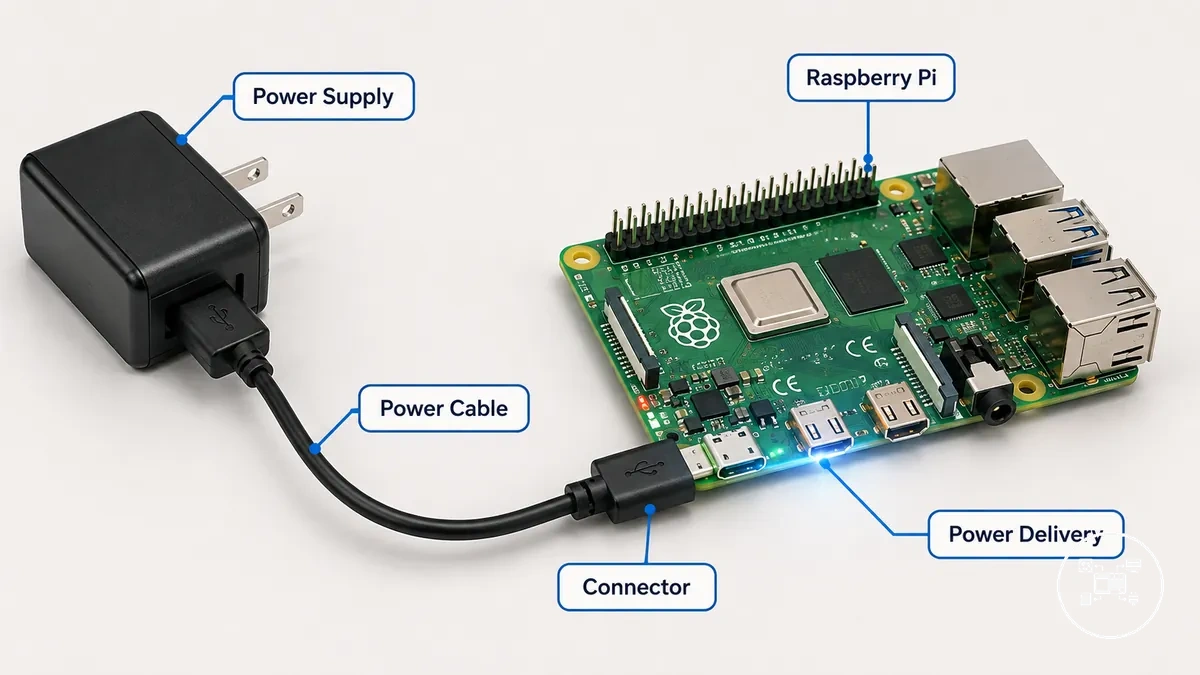
As one category of Raspberry Pi accessories, Raspberry Pi power accessories include power adapters, USB power cables, and connection components that together form the board's power-delivery path. For example, Raspberry Pi Ltd. specifies that the official Raspberry Pi 4 USB-C power supply delivers 5.1 V DC at up to 3.0 A (15.3 W), while the official Raspberry Pi 5 USB-C power supply delivers 5.1 V DC at up to 5.0 A (25.5 W) when used with a 5 A-rated USB-C cable. These model-specific specifications show that accessory suitability depends on the Raspberry Pi board's power requirements rather than on universal compatibility. The illustration below clarifies the relationship between the power supply, cable, connector, and Raspberry Pi board before the following sections evaluate their individual attributes.
Returning the Remaining Culture to Growing Conditions
The remaining culture should be returned to stable growing conditions immediately after a partial harvest so that culture recovery can continue under suitable environmental conditions. According to spirulina cultivation guidance from recognised culture-maintenance references, recovery depends on maintaining appropriate water level, light, temperature, nutrients, cleanliness, and gentle agitation rather than on replacing harvested biomass with an exact formula.
The remaining culture recovers more consistently when the following conditions are checked after harvesting.
The remaining culture recovers more consistently when the following conditions are checked after harvesting.
- Water level: Restore the culture to the normal operating level specified in the kit instructions using the recommended water source so evaporation and harvested volume do not leave the culture concentrated.
- Light and temperature: Return the culture to the same light exposure and temperature range recommended for the kit because sudden environmental changes can slow recovery and increase culture stress.
- Nutrients: Replenish nutrients only according to the kit manufacturer's instructions, as nutrient requirements depend on the harvesting method and culture condition rather than a universal dosing rule.
- Cleanliness: Ensure harvesting tools and containers are clean before returning the culture to its growing vessel to reduce the risk of contamination.
- Agitation: Resume the gentle agitation method recommended for the kit so nutrients, dissolved gases, and light exposure remain evenly distributed throughout the remaining culture.
If the remaining culture shows slower growth after harvesting, recovery time can depend on the amount of biomass removed and the culture's condition before harvest rather than indicating immediate failure. Continue with maintenance before harvesting as the regular ongoing routine once post-harvest recovery has been completed.
USB-C and Micro USB Power Adapters for Raspberry Pi Boards
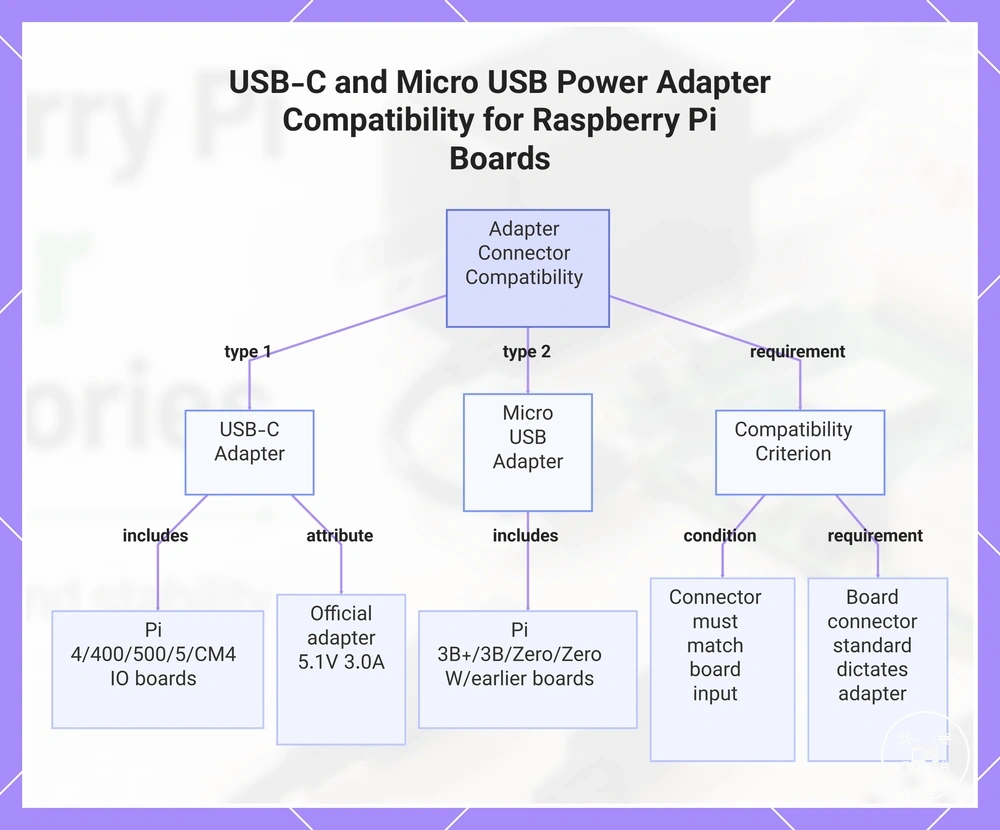
A USB-C power adapter and a Micro USB power adapter are differentiated by their connector, and each connector is compatible with specific Raspberry Pi board generations rather than all Raspberry Pi boards. According to Raspberry Pi Ltd., Raspberry Pi 4, Raspberry Pi 400, Raspberry Pi 500, Raspberry Pi 5, and Compute Module 4 IO boards use a USB-C power connector, while Raspberry Pi 3 Model B+, Raspberry Pi 3 Model B, Raspberry Pi Zero, Raspberry Pi Zero W, and earlier mainstream Raspberry Pi boards use a Micro USB power connector. The connector on the power adapter must physically match the Raspberry Pi board's power input for normal operation, making connector type the primary compatibility criterion.
Adapter compatibility is determined by the Raspberry Pi board's connector standard rather than by the power adapter alone.
Adapter compatibility is determined by the Raspberry Pi board's connector standard rather than by the power adapter alone. For example, according to Raspberry Pi Ltd., an official USB-C power adapter rated at 5.1 V DC and up to 3.0 A is designed for Raspberry Pi 4, whereas Raspberry Pi 3 Model B+ uses a Micro USB connector and therefore requires a compatible Micro USB power adapter even if both boards operate from a nominal 5 V supply. This connector distinction means a USB-C power adapter is compatible only with Raspberry Pi boards that provide a USB-C power input, while a Micro USB power adapter remains compatible only with Raspberry Pi boards equipped with a Micro USB power connector unless a separately supported adapter or conversion solution is intentionally used.
This chart shows the two power adapter connector types and their compatible Raspberry Pi board generations, along with the key compatibility rule.
This chart shows the two power adapter connector types and their compatible Raspberry Pi board generations, along with the key compatibility rule.
Power Cable Types, Connectors, and Switch Cable Options
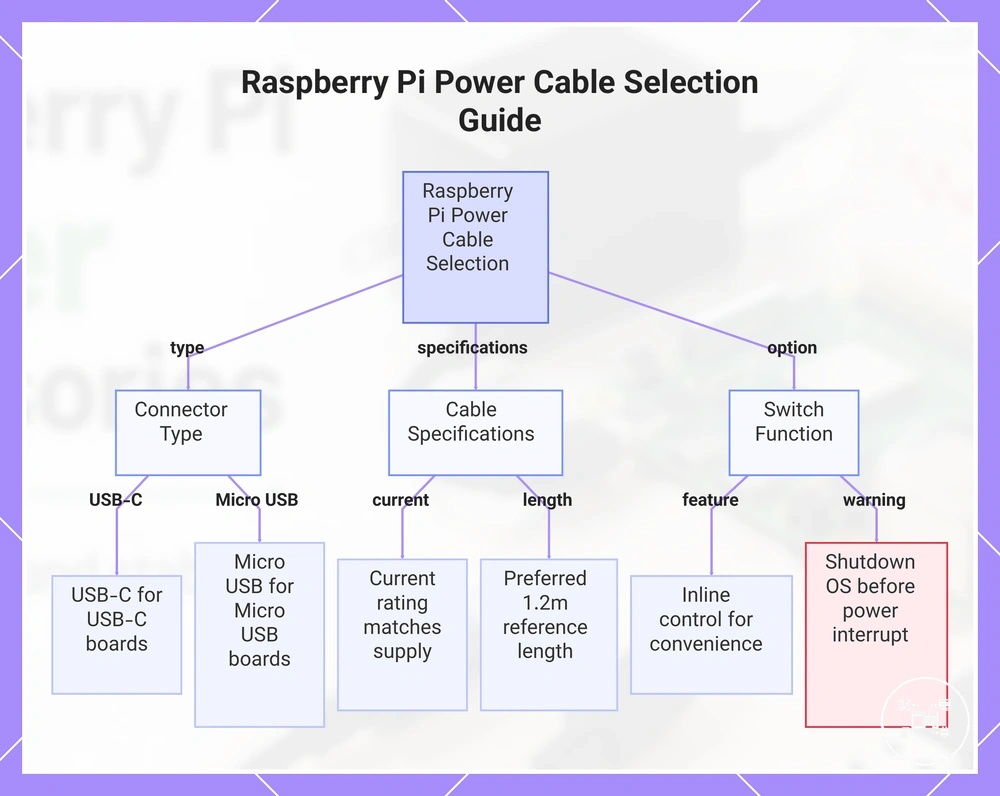
A Raspberry Pi power cable connects the power source to the board, and the appropriate cable type is defined by its connector, current-carrying capability, length, and optional switching function. USB-C cables serve boards with USB-C power inputs, while Micro USB cables serve boards with Micro USB power inputs. A switch cable adds an inline control that opens or closes the power connection, but it does not change the electrical requirements of the connected Raspberry Pi.
The connector must match the board’s physical power input.
The following checklist organises the cable attributes that affect connection suitability and everyday usability. The connector must match the board’s physical power input. Cable length must provide sufficient reach without placing the connector under tension, while its construction must support the current required by the intended setup. An inline switch changes how conveniently power can be interrupted, but the switch and cable must still be rated for the power connection they carry.
- Connector: Use USB-C for a Raspberry Pi board with a USB-C power input and Micro USB for a board with a Micro USB power input.
- Current capability: Match the cable rating to the supply and board combination; a cable intended for a lower-current connection does not qualify a higher-current setup.
- Cable length: Prefer a length that reaches the installation without excessive slack or tension. Raspberry Pi Ltd. specifies a 1.2 m, 17 AWG captive USB-C cable for its 27 W power supply, providing a model-specific reference rather than a universal maximum length.
- Switch function: Use an inline switch for convenient physical power control only when its connector and electrical rating suit the intended board and supply.
Usage conditions determine which cable option is suitable. For example, Raspberry Pi Ltd. specifies that its Raspberry Pi 5-oriented 27 W supply delivers 5.1 V at 5 A through a 1.2 m, 17 AWG USB-C cable, so a separate cable used under the same condition must support the required connector and current rather than merely fit the port. A switch cable can simplify bench or enclosure access, but the operating system should be shut down before the switch interrupts power so that convenience does not replace the normal software shutdown process.
Usage conditions determine which cable option is suitable.
This chart shows the key attributes and options for selecting a suitable power cable for a Raspberry Pi board, including connector type, cable specifications, and switch function.
Raspberry Pi Power Supply Compatibility Factors
Raspberry Pi power supply compatibility is determined by whether the board model, connector type, power requirements, and connected peripherals all match the capabilities of the selected power accessory. According to Raspberry Pi Ltd., Raspberry Pi 4 is specified for an official 5.1 V, 3.0 A USB-C power supply, while Raspberry Pi 5 is specified for an official 5.1 V, 5.0 A USB-C power supply to enable its full USB peripheral power capability when supported by a suitable 5 A cable. A compatibility check should therefore verify both the physical connector and the electrical specification before the accessory is used. :contentReference[oaicite:0]{index=0}
The table below organises the primary compatibility criteria that should be checked before connecting a Raspberry Pi power accessory.
The table below organises the primary compatibility criteria that should be checked before connecting a Raspberry Pi power accessory. These factors also form part of broader power compatibility checks by relating power-specific requirements to complete Raspberry Pi accessory suitability.
| Entity/Part | Attribute/Criterion | Value/Condition | Effect/Decision |
|---|---|---|---|
| Board model | Supported power input | Must match the Raspberry Pi model specification published by Raspberry Pi Ltd. | Qualifies whether the selected power accessory is suitable. |
| Connector type | Physical interface | USB-C for Raspberry Pi 4, Raspberry Pi 5, and newer USB-C models; Micro USB for Raspberry Pi 3 series, Raspberry Pi Zero series, and earlier Micro USB models. | Prevents physical connector incompatibility. |
| Power requirements | Voltage and current | Official supplies provide 5.1 V DC with model-specific current ratings, including 3.0 A for Raspberry Pi 4 and 5.0 A for Raspberry Pi 5. | Supports stable operation when the electrical specification matches the board. |
| Peripherals | Additional current demand | USB storage devices, cameras, HATs, and other powered accessories increase total current demand. | Determines whether the selected power supply remains suitable for the complete configuration. |
Compatibility remains conditional because the complete Raspberry Pi configuration determines the required power capacity. For example, according to Raspberry Pi Ltd., a Raspberry Pi 5 operating with multiple USB peripherals is designed to use the official 5.1 V, 5.0 A USB-C power supply, while a Raspberry Pi 4 is specified with an official 5.1 V, 3.0 A USB-C supply under its supported operating conditions. Checking the board model, connector type, power requirements, and connected peripherals together provides a practical compatibility assessment without assuming that one power supply is suitable for every Raspberry Pi system. :contentReference[oaicite:1]{index=1}
Choosing Raspberry Pi Power Accessories for Reliable Operation
Choosing Raspberry Pi power accessories requires matching the power supply, cable, and connector to the exact board model, connected peripherals, and sustained workload. The main selection criteria are connector compatibility, supported voltage and current, cable current capability, and sufficient peripheral power for the intended configuration. Raspberry Pi Ltd. specifies 5.1 V DC at 3.0 A for its 15 W USB-C supply for Raspberry Pi 4 and Raspberry Pi 400, while its 27 W USB-C supply provides up to 5.1 V DC at 5.0 A for Raspberry Pi 5. :contentReference[oaicite:0]{index=0} These model-specific values provide a measurable selection boundary for reliable operation rather than a universal specification. :contentReference[oaicite:1]{index=1}
The products below are useful examples for comparing available options.
The products below are useful examples for comparing available options. Before buying, check that the compatibility criteria, key features, and product details match your needs.
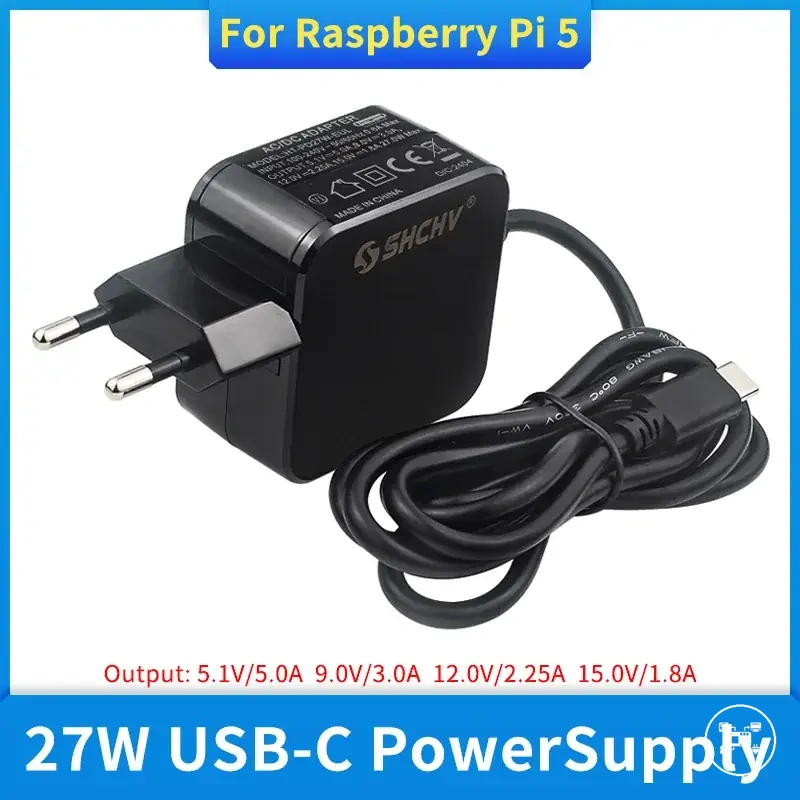
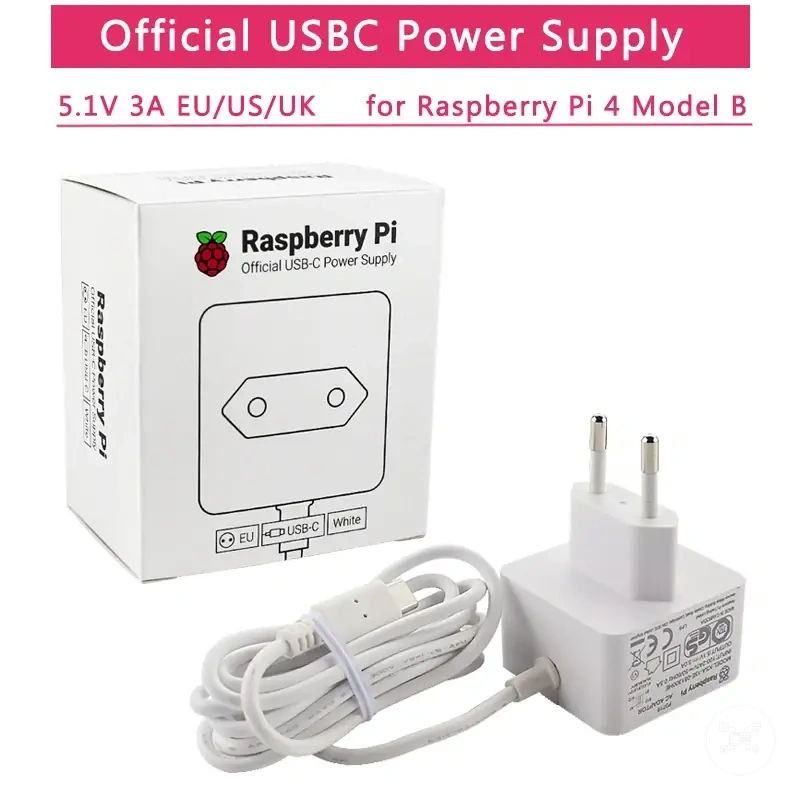
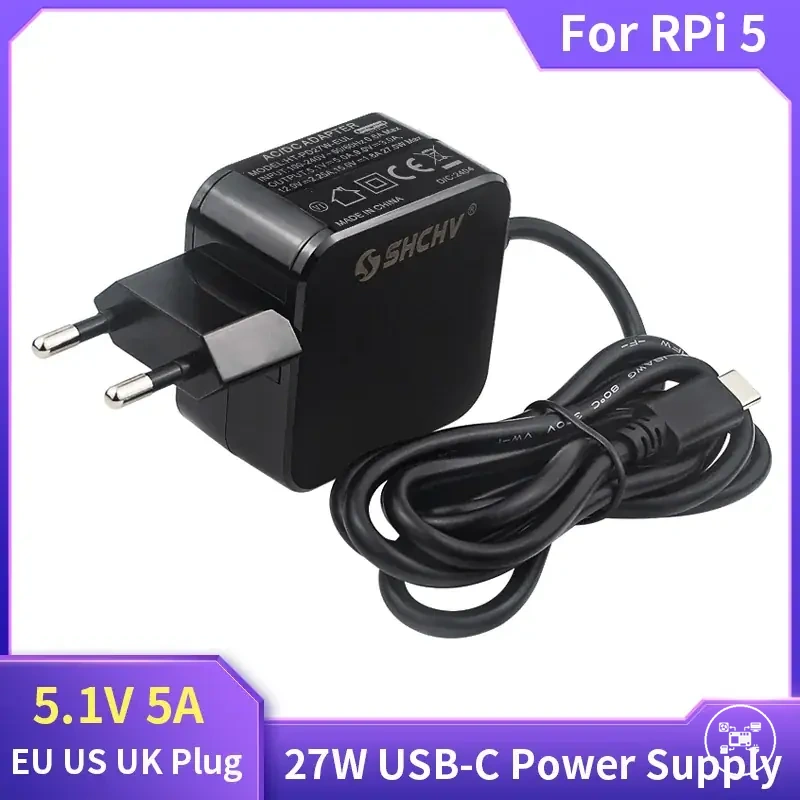
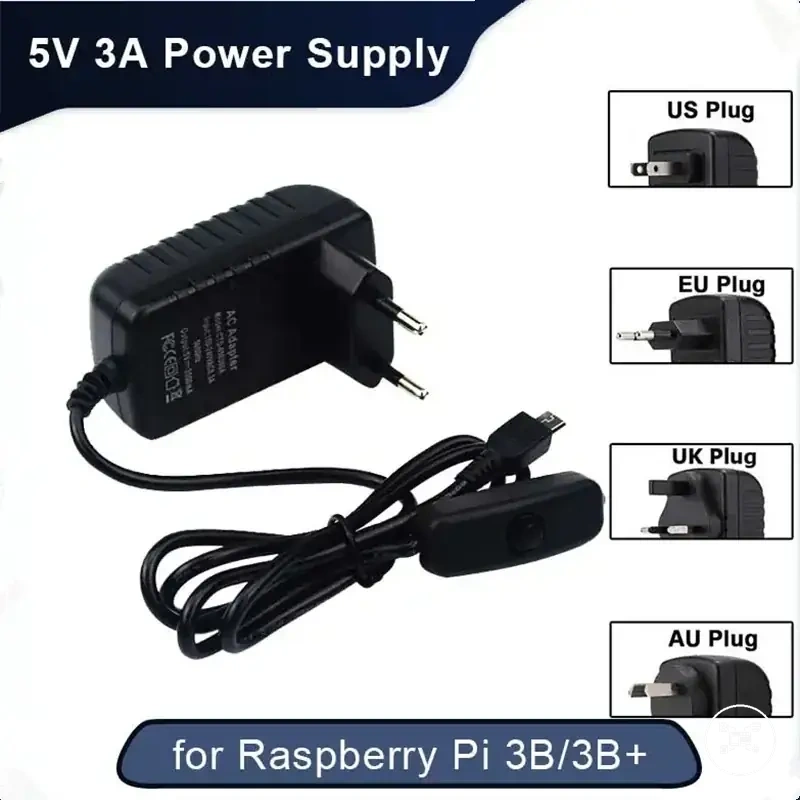
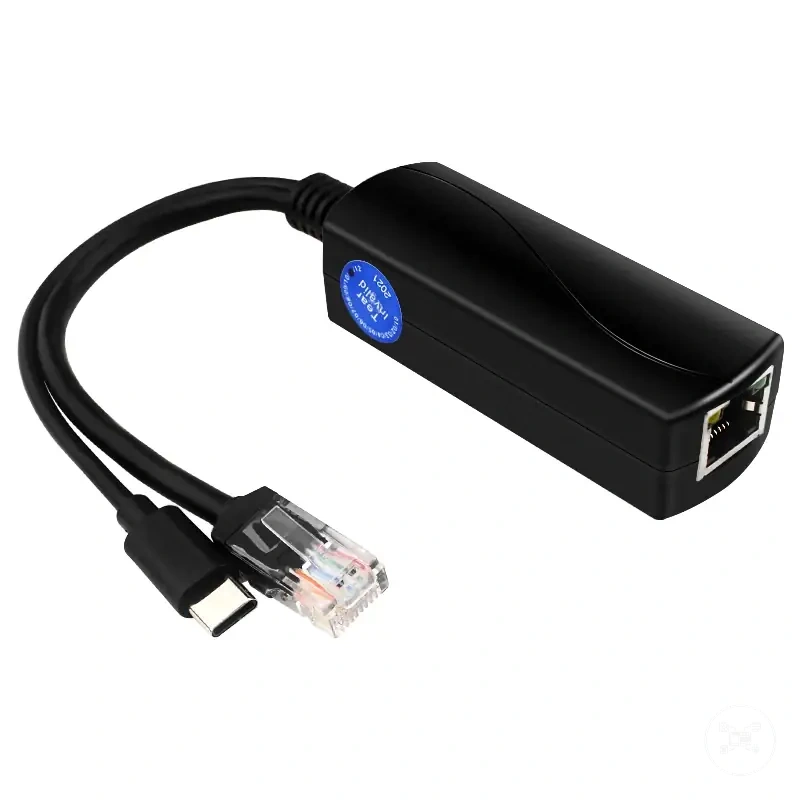
The checklist below organises accessory decisions by the condition each component must satisfy. The board model determines the accepted connector and input profile, while the peripherals and workload determine how much of the available power capacity the setup may use. The cable must support the selected supply’s current and maintain the required connector at both ends. Compatibility is complete only when the supply, cable, board, and connected hardware qualify as one power-delivery path.
- Board model: Identify the exact Raspberry Pi model and use its published input specification as the selection boundary.
- Power supply: For Raspberry Pi 4 or Raspberry Pi 400, Raspberry Pi Ltd. specifies its 15 W, 5.1 V, 3.0 A USB-C supply; for Raspberry Pi 5 with higher-power USB peripherals, it specifies a supply capable of 5.1 V at 5.0 A. :contentReference[oaicite:2]{index=2}
- Power cable: Select a cable whose connector and current rating match the chosen supply and board; physical fit alone does not establish electrical suitability.
- Peripherals: Include USB storage, cameras, displays powered from the board, HATs, and other connected hardware in the power assessment.
- Operating condition: Evaluate the sustained workload rather than an unloaded startup test, because the complete configuration determines whether the available power remains sufficient.
For a Raspberry Pi 4 desktop configuration, the official 15 W supply provides a supported reference of 5.1 V at 3.0 A. For Raspberry Pi 5, Raspberry Pi Ltd. states that a 5 V, 5 A supply is recommended when higher-power peripherals such as SSDs or hard drives use the board’s USB ports; with a 3 A supply, lower-power peripherals are the supported condition. :contentReference[oaicite:3]{index=3} The official 27 W supply also raises Raspberry Pi 5’s combined USB current limit from the default 600 mA to 1.6 A, which makes peripheral demand a direct decision factor. :contentReference[oaicite:4]{index=4} These scenarios show why accessory suitability must be evaluated for the complete setup rather than the board alone.
For a Raspberry Pi 4 desktop configuration, the official 15 W supply provides a supported reference of 5.1 V at 3.0 A .
After selecting a compatible supply, cable, and connector, follow the relevant power setup steps for the intended configuration. Existing undervoltage warnings, resets, or unstable behaviour should be assessed under Raspberry Pi power accessory issues rather than treated as selection criteria alone. Long-term reliable operation also requires inspecting connections and maintaining reliable power accessories after installation.
After selecting a compatible supply, cable, and connector, follow the relevant power setup steps for the intended configuration.
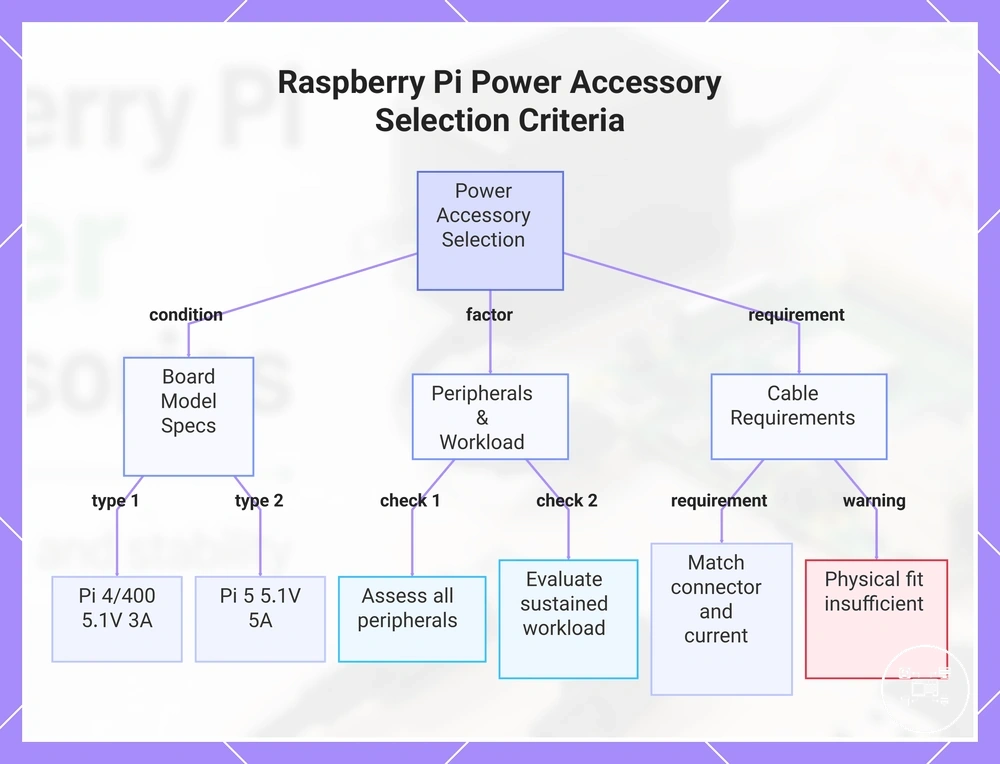
This chart shows the three main selection factors for choosing power accessories: board model specs, peripherals and workload, and cable requirements.