Reliable Raspberry Pi Accessories for Durable Value
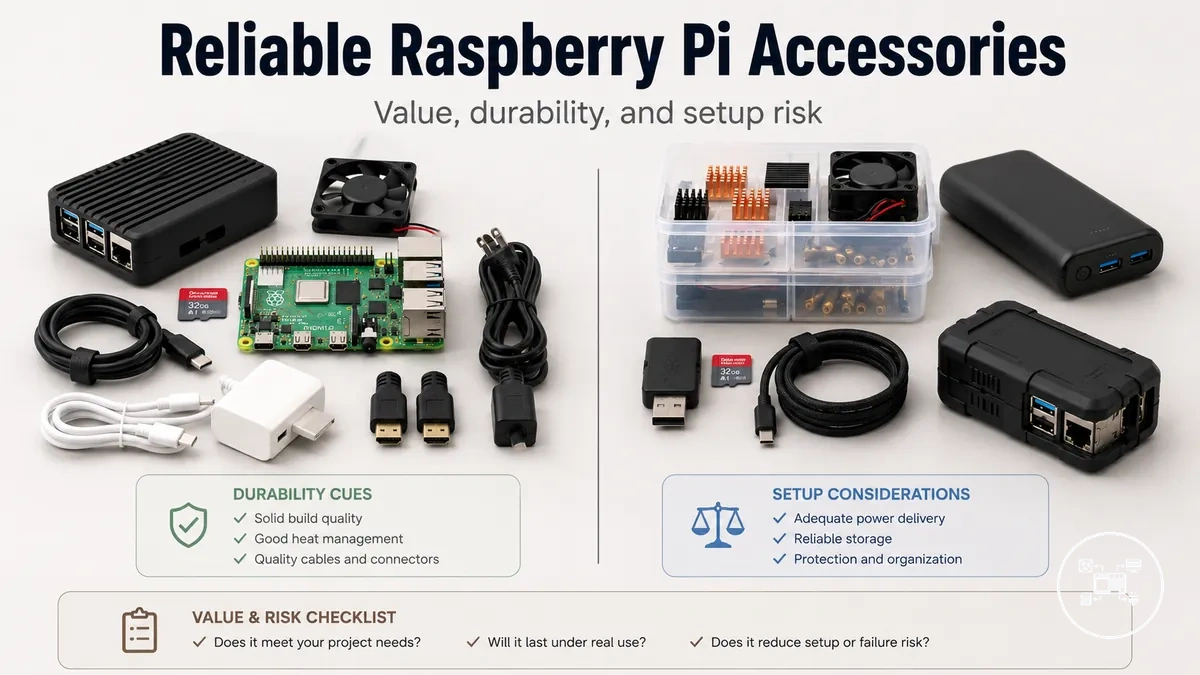
Reliable Raspberry Pi accessories are accessories that consistently maintain setup stability, preserve compatibility with the intended Raspberry Pi model, and reduce avoidable replacement risk during long-term use. Durable value comes from selecting accessories that match the board, workload, and operating conditions instead of focusing only on the purchase price. Reliable accessories cannot guarantee a specific service life, but they can reduce common failures caused by poor power delivery, inadequate cooling, unreliable storage adapters, or poorly fitting cables and enclosures.
Durable value comes from selecting accessories that match the board, workload, and operating conditions instead of focusing only on the purchase price.
Reliable Raspberry Pi accessories usually deliver better cost-value because accessory quality influences maintenance effort, system stability, and replacement frequency over time. According to the Raspberry Pi Foundation, Raspberry Pi 5 requires a USB-C power supply capable of providing up to 5 V at 5 A (25 W) to support the board and high-power peripherals under full operating conditions. For example, using a power supply that meets this specification together with a compatible case, cooling solution, quality cable, and dependable storage adapter can reduce avoidable instability caused by insufficient power rather than by the Raspberry Pi itself.
Consider a Raspberry Pi operating continuously as a home server or media centre for months.
Consider a Raspberry Pi operating continuously as a home server or media centre for months. In that situation, reliable power, effective cooling, durable cables, and secure storage connections become more valuable than a small upfront saving because replacing failed accessories or diagnosing intermittent faults usually costs more time than the initial price difference. For broader guidance across compatible accessory categories, visit the Raspberry Pi accessories hub.
A common misconception is that the most expensive accessory is automatically the most reliable.
A common misconception is that the most expensive accessory is automatically the most reliable. In practice, reliable Raspberry Pi accessories are defined by proven compatibility, appropriate electrical or mechanical performance, and consistent build quality for the intended use case, which provides a stronger foundation for evaluating reliability throughout the rest of this guide.
Table of Contents
What Reliability Means for Raspberry Pi Accessories
Reliability for Raspberry Pi accessories is the ability of an accessory to deliver consistent performance under the setup conditions for which it is designed. For Raspberry Pi accessories, reliability depends on the accessory type, its compatibility with the board, the operating environment, and whether it continues performing its intended function without introducing avoidable instability or replacement risk. Reliability is therefore conditional on the board model, workload, enclosure, temperature, and physical handling rather than being an absolute property.
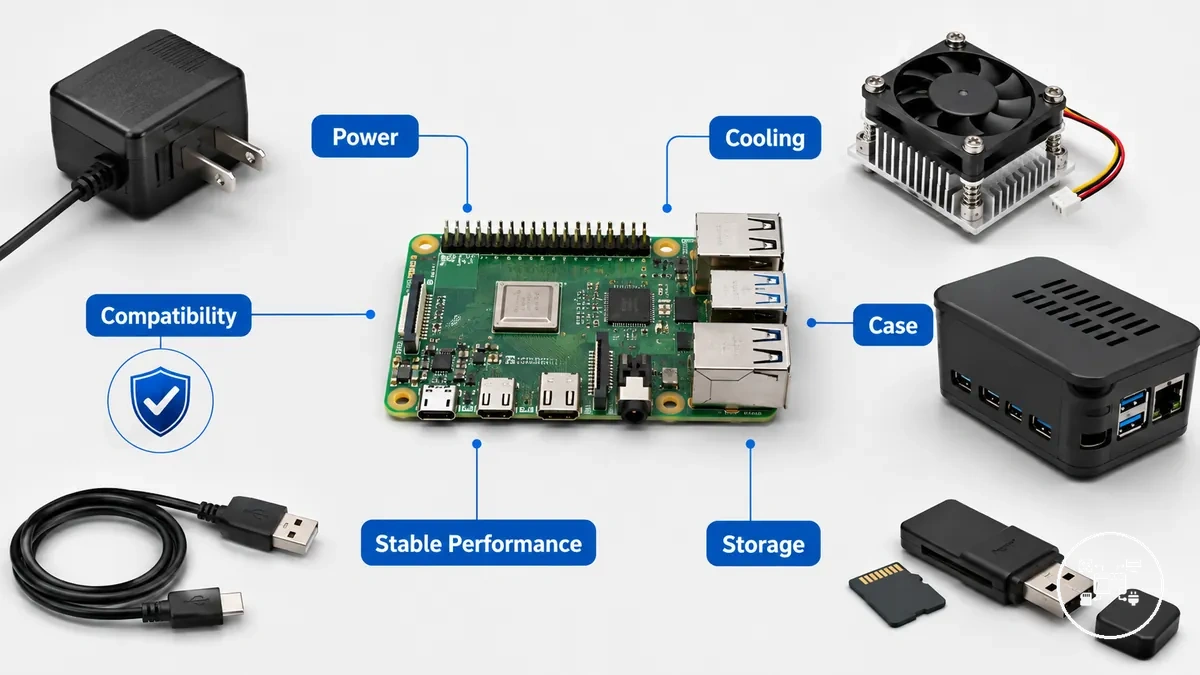
A Raspberry Pi running continuously illustrates how reliability changes with operating conditions. For example, according to the Raspberry Pi Foundation, Raspberry Pi 5 can require a USB-C power supply capable of delivering up to 5 V at 5 A (25 W) when powering the board and high-power peripherals; using an accessory that cannot supply this requirement can reduce setup stability under that workload. Likewise, dependable cooling, storage adapters, cables, and enclosures help maintain stable performance because each accessory type supports a different reliability attribute, including power delivery, heat management, secure connections, physical protection, durability, and lower replacement risk.
Reliability does not mean choosing the most expensive or newest Raspberry Pi accessory.
Reliability does not mean choosing the most expensive or newest Raspberry Pi accessory. It means choosing an accessory whose documented specifications, compatibility, build quality, and operating conditions match the intended Raspberry Pi setup, while recognising that no accessory can guarantee a failure-free system because long-term performance also depends on workload, environment, installation quality, and handling.
Cheap Accessories Versus Reliable Accessories
Cheap accessories and reliable accessories should be compared by their ability to maintain setup stability, stated compatibility, build quality, connector durability, heat control, and expected service life rather than by purchase price alone. Cheap accessories can represent good value for light or temporary Raspberry Pi projects, while reliable accessories often reduce replacement likelihood and maintenance in long-term or continuously operating systems. The practical comparison is therefore price versus reliability risk, not price alone.
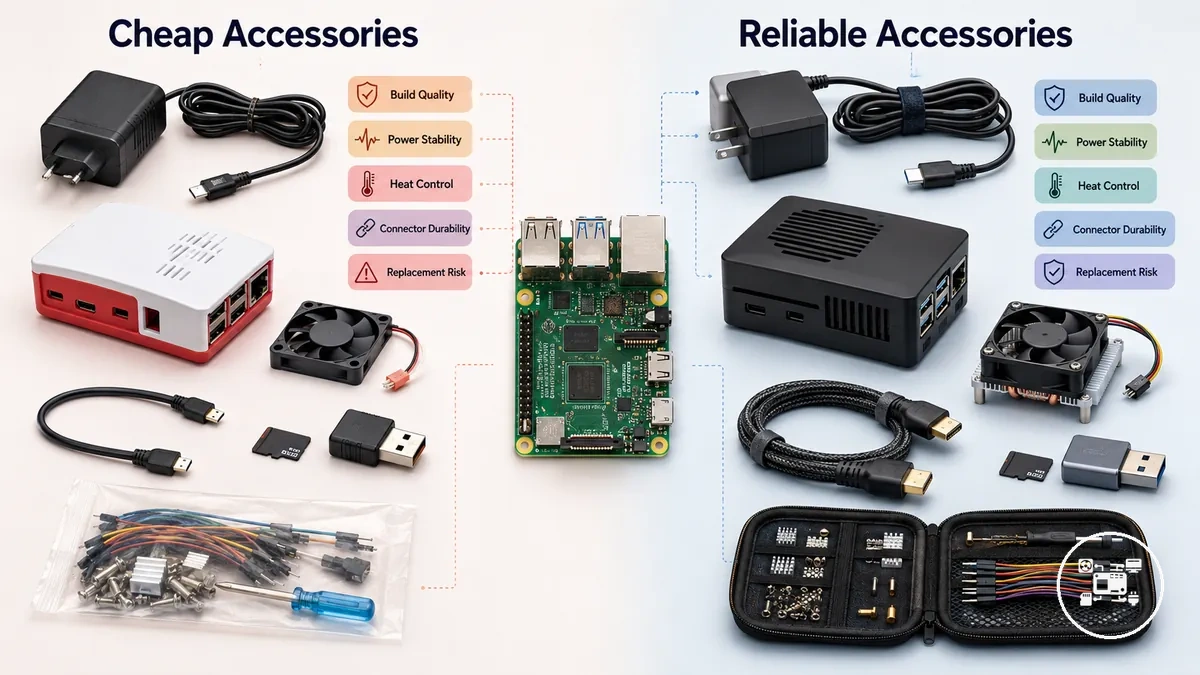
| Cheap accessory signal | Reliability implication |
|---|---|
| Lower-cost power supply | Suitable only when its stated voltage and current specifications match the Raspberry Pi model and connected peripherals; otherwise power stability may be reduced under sustained load. |
| Basic case | Adequate for open or lightly loaded systems, while enclosed or warmer environments benefit from improved airflow and stronger build quality. |
| Minimal cooling | Often sufficient for short or low-load tasks, but continuous workloads benefit from more effective heat control. |
| Budget cable | Can perform well when connector fit and cable quality meet the intended use, although repeated connection cycles increase the importance of connector durability. |
| Low-cost storage adapter | Acceptable when stated compatibility matches the storage device, but stronger construction can reduce connection failures during extended use. |
| Budget accessory kit | Overall reliability depends on the quality of each included component rather than the total kit price. |
For temporary experiments, classroom exercises, first Raspberry Pi setups, or low-load projects, cheap accessories are often adequate because operating time is limited and occasional replacement has a smaller practical impact. By contrast, always-on home servers, media centres, network appliances, and enclosed builds place greater demands on power stability, connector durability, and heat control, making reliable accessories a better long-term choice. For example, the Raspberry Pi Foundation specifies that Raspberry Pi 5 can require a USB-C power supply capable of delivering up to 5 V at 5 A (25 W) when powering the board together with high-power peripherals, illustrating why matching accessory specifications becomes more important under heavier workloads.
A common misconception is that cheap accessories are poor quality by default.
A common misconception is that cheap accessories are poor quality by default. In reality, false savings occur only when lower build quality, incomplete stated compatibility, weaker connector durability, or inadequate heat control leads to repeated replacement or troubleshooting costs that outweigh the initial saving. Comparing these reliability criteria provides a more accurate buying decision, particularly when considering accessory kit quality tradeoffs between complete kits and individually selected components.
Reliability Factors That Affect Long-Term Use
Reliability factors that affect the long-term use of Raspberry Pi accessories are the operating conditions that determine whether an accessory continues performing its intended function over extended periods. The primary reliability factors are use duration, electrical load, heat, physical strain, fit, and repeated handling, because each influences uptime, wear, connection stability, safety, or replacement need under specific operating conditions. These criteria provide a practical framework for evaluating long-term reliability without assuming an exact lifespan or universal compatibility.
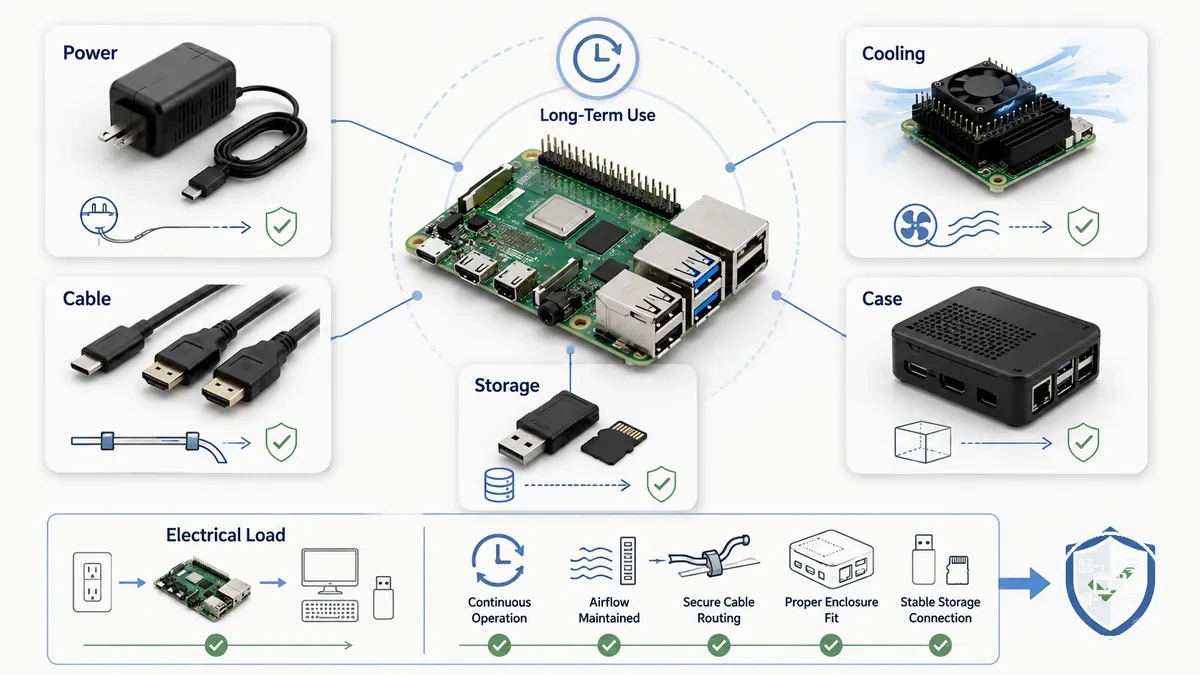
| Accessory group | Reliability attribute | Condition to check | Effect on long-term use |
|---|---|---|---|
| Power supply | Electrical stability | Voltage and current specifications match the Raspberry Pi model and connected peripherals | Supports stable uptime and reduces unexpected shutdowns under sustained electrical load |
| Cooling | Heat management | Cooling capacity matches continuous workload and enclosure airflow | Helps maintain consistent performance and limits heat-related throttling during long-term use |
| Case | Physical fit | Secure board mounting with unobstructed ventilation and port alignment | Reduces physical strain and supports long-use conditions |
| Cable | Connector durability | Secure fit with limited movement during repeated handling | Reduces connection wear and intermittent signal or power interruptions |
| Storage | Connection stability | Compatible interface with secure attachment throughout operation | Helps reduce data interruption and unnecessary replacement need |
For example, a Raspberry Pi used continuously as a home server experiences sustained electrical load and ongoing heat generation inside its enclosure. According to the Raspberry Pi Foundation, Raspberry Pi 5 can require a USB-C power supply capable of delivering up to 5 V at 5 A (25 W) when the board powers itself together with high-power USB peripherals. Under those conditions, matching the power supply and cooling accessories to the operating workload improves the likelihood of stable uptime throughout long-use conditions.
For example, a Raspberry Pi used continuously as a home server experiences sustained electrical load and ongoing heat generation inside its enclosure.
Reliability factors follow an entity-attribute-value relationship in which the accessory group is the entity, the reliability characteristic is the attribute, the operating condition provides the value, and the resulting effect indicates its influence on uptime, wear, safety, or replacement need. A correctly fitting case, secure cable connection, appropriate cooling, and compatible storage connection should therefore be evaluated together because each addresses a different source of setup stress rather than the same reliability criterion. The practical decision is to judge accessories by the conditions they are expected to operate under instead of assuming that any single feature determines long-term reliability.
Power Stability and Current Headroom
Power supply quality and current headroom are key attributes that affect long-term Raspberry Pi stability because the rated output, voltage stability, connector type, cable quality, and setup load determine whether sufficient power is available during operation. According to the Raspberry Pi Foundation, Raspberry Pi 5 can require a USB-C power supply capable of delivering up to 5 V at 5 A (25 W) when powering the board together with high-power USB peripherals. Matching the power supply's rated output to the expected setup load is therefore the primary criterion for maintaining stable operation under long-use conditions.
- Connector type: Use the power connector specified for the Raspberry Pi model so the rated voltage and current can be delivered reliably.
- Rated output: Choose a power supply whose voltage and current ratings satisfy the board and connected peripheral requirements.
- Cable quality: Use a cable designed for the required current because excessive cable resistance can reduce voltage stability under sustained load.
- Current headroom: Keep spare output capacity above normal operating demand so temporary increases in peripheral load are less likely to contribute to resets, CPU throttling, or peripheral instability.
Current headroom is the available difference between a power supply's maximum rated output and the setup's actual power demand. For example, according to the Raspberry Pi Foundation, a Raspberry Pi 5 operating with high-power USB devices can require the full 25 W capability of a compatible USB-C power supply, making additional headroom beneficial when peripheral demand changes during continuous operation. After these criteria have been established, power accessory reliability provides more detailed guidance on selecting suitable power accessories for long-term use.
Current headroom is the available difference between a power supply's maximum rated output and the setup's actual power demand.
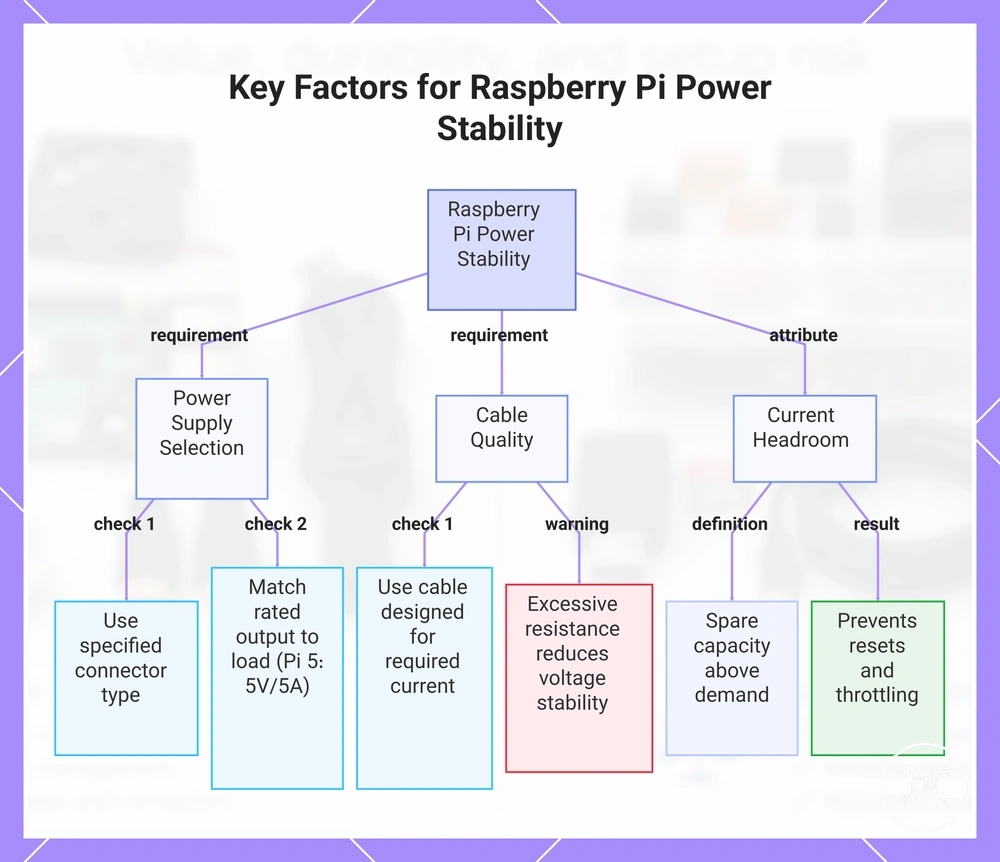
This chart shows the main criteria for ensuring stable power delivery to a Raspberry Pi, including power supply selection, cable quality, and current headroom.
Cooling Consistency and Heat Control
A cooling accessory supports stable Raspberry Pi operation when its airflow and heat transfer remain suitable for the setup's thermal load, workload, and enclosure. Raspberry Pi states that cooling is optional for normal Raspberry Pi 5 use, while a heavy continuous load can cause thermal throttling if heat is not removed effectively. The local decision is therefore to match cooling capacity to sustained workload and enclosure airflow rather than assume that active cooling is required for every setup.
- Thermal load: Intermittent tasks can suit passive cooling, while sustained processor workloads create a condition in which active airflow may better limit throttling.
- Fan quality: Consistent fan speed and unobstructed airflow support heat removal; unstable operation or restricted airflow can increase noise and reduce cooling consistency.
- Heatsink contact: Even contact between the heatsink and processor supports heat transfer, while incomplete contact limits the heatsink's ability to move heat away from the chip.
- Enclosure: Open ventilation supports warm-air escape, whereas a restricted enclosure can retain heat and require more active airflow under the same workload.
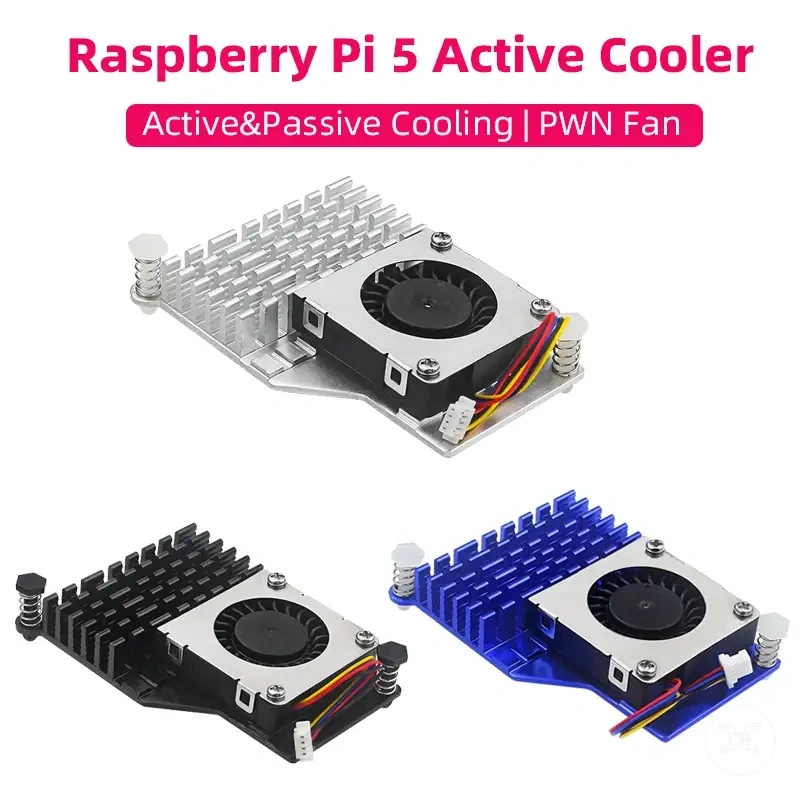
For example, Raspberry Pi specifies that the Raspberry Pi 5 Active Cooler combines an aluminium heatsink with a temperature-controlled blower fan and is intended to maintain cooling under heavy loads. This example shows that passive cooling can remain suitable for lighter or intermittent workloads, while active cooling becomes more relevant when sustained processing and restricted enclosure airflow increase the thermal load. These conditions provide the basis for evaluating cooling accessory reliability without assuming fixed temperatures, fan lifespans, or universal cooling requirements.
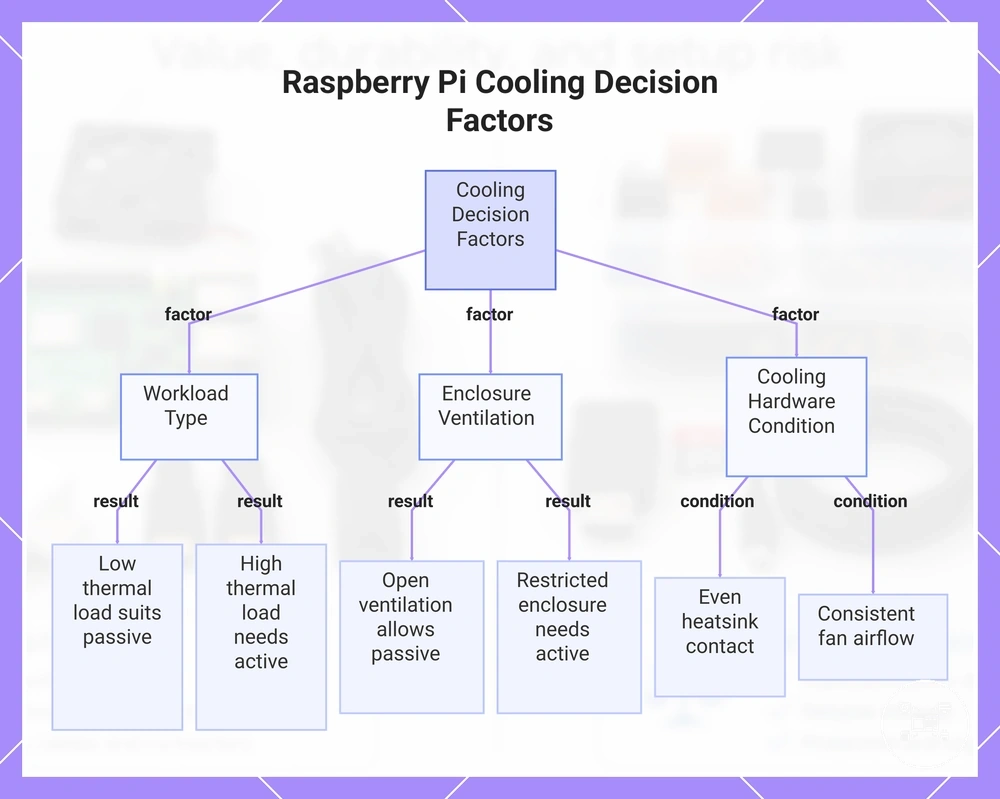
This chart shows the key factors that determine whether passive or active cooling is suitable for a Raspberry Pi setup.
This chart shows the key factors that determine whether passive or active cooling is suitable for a Raspberry Pi setup.
Case Protection and Enclosure Material
Case protection and enclosure material improve Raspberry Pi accessory reliability when the case provides the appropriate balance of case durability, board fit, port access, ventilation, and protection level for the intended operating environment. Material strength alone is not the deciding factor because an enclosure that restricts airflow, GPIO access, or cable clearance can reduce practical reliability even if it offers greater physical protection. This section follows the supplied section evidence and focuses on physical enclosure trade-offs rather than general case selection. :contentReference[oaicite:0]{index=0}
| Case type | Material or fit signal | Trade-off | Reliability implication |
|---|---|---|---|
| Plastic enclosure | Good board fit with unobstructed port access | Lower impact resistance than many aluminium enclosures | Suitable when accessibility, electrical insulation, and easy cable routing are higher priorities than maximum physical protection |
| Aluminium enclosure | Higher mechanical strength with conductive enclosure material | May reduce wireless performance or GPIO accessibility if the enclosure design limits clearance | Can improve physical protection and passive heat transfer when ventilation remains unobstructed |
| Open case | Maximum ventilation and unrestricted connector access | Minimal protection from dust or accidental contact | Appropriate for development benches and testing environments where accessibility is prioritised |
| Fan-supported enclosure | Enclosed protection with assisted airflow | Cooling effectiveness depends on unobstructed intake and exhaust paths | Supports more consistent operation during sustained processor workloads when airflow is maintained |
For example, enclosure manufacturers including Bud Industries classify aluminium and plastic enclosures as different material categories with distinct mechanical and environmental characteristics rather than universally superior options. In a Raspberry Pi system operating continuously inside an enclosed cabinet, an aluminium case with unobstructed ventilation may improve passive heat dissipation, whereas a well-designed plastic enclosure may provide better GPIO accessibility and cable clearance for development or prototyping. These physical trade-offs provide the context for evaluating case durability and fit without expanding this section into a complete enclosure buying guide.
Cable Strain and Connector Quality
Cable strain and connector quality affect Raspberry Pi reliability by determining whether a cable maintains secure contact and stable signal or power delivery during repeated handling. The key values are a connector that remains fully seated, cable construction that tolerates the intended bend direction, shielding suited to the signal environment, and strain relief that transfers pulling force away from the connector joint. The local decision condition is whether cable routing and case clearance prevent repeated bend stress and port stress during normal use. :contentReference[oaicite:0]{index=0}
- Connector fit: The plug should remain fully inserted without lateral movement that could contribute to intermittent disconnects.
- Cable construction: Cable thickness should suit the required routing space without forcing pressure against the Raspberry Pi port.
- Bend stress: Repeated flexing at one point increases mechanical loading, while routing the bend away from the connector reduces concentrated strain.
- Shielding: Shielding can support signal stability in electrically noisy conditions, but it does not correct a loose connector or damaged cable.
- Strain relief: A flexible transition between the cable and plug reduces direct pulling force at the termination and can lower the likelihood of port stress.
For example, suppose a cable must turn through approximately 90 degrees within 10 mm of the connector because the enclosure opening is narrow; this illustrative routing condition concentrates bend stress near the plug and increases the chance of intermittent behaviour when the cable is moved. Providing more clearance or redirecting the cable so the bend begins farther from the connector reduces repeated loading on the termination and the Raspberry Pi port, while the exact safe bend radius remains specific to the cable manufacturer's construction data.
Storage Adapter Dependability
Storage adapter dependability is the adapter’s ability to maintain connection stability during booting and data access under the intended workload. The required conditions are correct interface fit, secure construction, limited cable movement, controlled heat, suitable media quality, and stable power; weaknesses in any of these conditions can increase the likelihood of disconnects, corruption risk, or replacement need. The local decision is therefore to assess the adapter together with the boot media, data workload, and power conditions rather than treating adapter type as a complete reliability value. :contentReference[oaicite:0]{index=0}
- Interface fit: The adapter and storage media should use matching interfaces and remain fully seated during operation.
- Build quality: The connector housing and cable termination should remain mechanically stable during repeated insertion and handling.
- Cable movement: Movement at the connector can interrupt data transfer or boot access when the physical connection is loose or strained.
- Heat: Sustained data workloads require enough surrounding airflow to prevent heat accumulation around the adapter and media.
- Power stability: Stable power must be maintained across the Raspberry Pi, storage adapter, and media because voltage interruption during writing can increase corruption risk.
For example, suppose a Raspberry Pi performs an illustrative 100 GB backup through a storage adapter while the cable is moved repeatedly inside a confined enclosure. Under that condition, sustained data activity, connector movement, and heat act together, so a temporary disconnection can interrupt the transfer and increase the replacement or recovery burden. No universal transfer limit, temperature threshold, or insertion-cycle rating applies to every storage adapter; those values must be verified in the adapter and storage-media documentation for the exact interface and workload. :contentReference[oaicite:1]{index=1}
Cost-Value Tradeoffs Across Accessory Categories
Cost-value tradeoffs across accessory categories depend on whether the value-sensitive attribute reduces avoidable replacement or improves stable operation under the intended operating condition. Each accessory category carries a different reliability burden, so the decision outcome should be based on the category, workload, and replacement consequence rather than purchase price alone. The table below organises these category-specific cost-value relationships to support a practical selection decision. :contentReference[oaicite:0]{index=0}
| Accessory category | Value-sensitive attribute | Low-risk condition | Higher-risk condition | Decision cue |
|---|---|---|---|---|
| Power | Stable voltage and current delivery | Light processor load with few connected peripherals | Continuous operation or multiple power-demanding peripherals | Additional spending is usually justified when uninterrupted operation depends on stable power delivery. |
| Cooling | Heat transfer capacity | Intermittent workloads with adequate airflow | Sustained processing inside an enclosed case | Improved cooling provides clearer value when prolonged workloads increase thermal demand. |
| Case | Protection, ventilation, and board fit | Indoor development or fixed desktop use | Frequent transport or restricted ventilation | Extra spending becomes more valuable when physical protection or airflow directly affects reliability. |
| Cable | Connector durability and strain relief | Fixed installation with minimal cable movement | Repeated connection cycles or frequent handling | Better construction can reduce connector wear and avoidable replacement over long-use conditions. |
| Storage | Connection stability | Occasional booting and light file access | Frequent boot cycles or sustained data transfers | Higher-quality adapters become more valuable when uninterrupted storage access supports continuous operation. |
For example, a Raspberry Pi used for classroom demonstrations a few hours each week places different demands on accessories than a system operating continuously throughout the day. In the first case, a basic enclosure and passive cooling may remain sufficient, while continuous workloads increase the practical value of dependable power delivery, effective cooling, durable cable connections, and stable storage interfaces because replacement interruptions become more disruptive. :contentReference[oaicite:1]{index=1}
For a broader evaluation of purchasing decisions beyond individual categories, see Raspberry Pi accessories cost and value .
These category-based decision signals help compare spending where reliability improvements are most likely to provide durable value without treating every accessory category equally. For a broader evaluation of purchasing decisions beyond individual categories, see Raspberry Pi accessories cost and value. :contentReference[oaicite:2]{index=2}
Avoidable Risks from Low-Quality Accessories
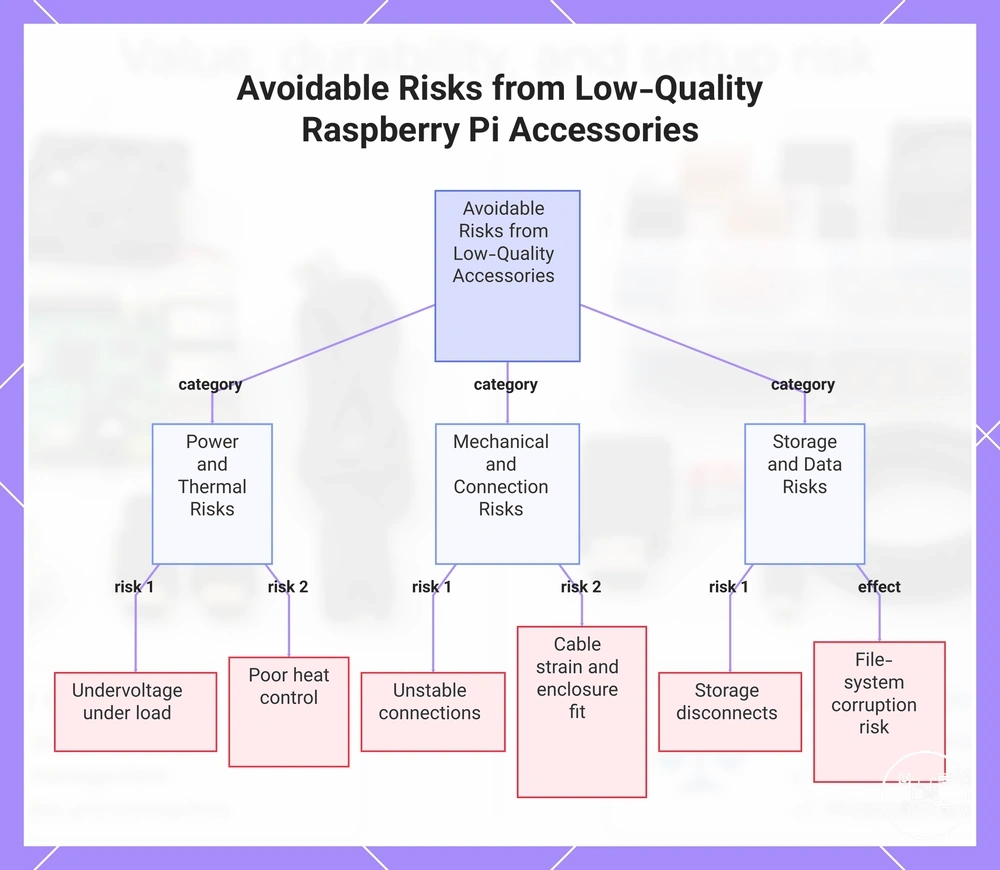
Low-quality accessories increase avoidable risks when their electrical, thermal, or mechanical characteristics do not match the Raspberry Pi model and operating conditions. These risks are conditional rather than guaranteed and commonly include undervoltage, unstable connections, inadequate heat control, poor enclosure fit, cable strain, and storage disconnects. According to Raspberry Pi documentation, Raspberry Pi 5 supports operation from a 5 V 3 A USB-C supply, while a 5 V 5 A USB-C PD supply enables the board to provide higher USB peripheral current, making power capability a model-specific condition rather than a universal requirement. :contentReference[oaicite:0]{index=0}
Low-quality accessories increase avoidable risks when their electrical, thermal, or mechanical characteristics do not match the Raspberry Pi model and operating conditions.
The checklist below groups avoidable risks by accessory condition and the likely effect so that reliability can be assessed before long-use deployment rather than after instability occurs. :contentReference[oaicite:1]{index=1}
- Undervoltage: Power accessories that cannot maintain the required voltage under operating load can contribute to reduced performance, instability, or unexpected resets, particularly when multiple USB peripherals increase current demand. Raspberry Pi specifies the 5 V 3 A and 5 V 5 A operating conditions for Raspberry Pi 5. :contentReference[oaicite:2]{index=2}
- Unstable connections: Loose connectors, poor terminal construction, or repeated movement increase the likelihood of intermittent power or data interruptions during operation. :contentReference[oaicite:3]{index=3}
- Poor heat control: Restricted airflow, inadequate heatsink contact, or ineffective cooling increase the likelihood of processor thermal throttling during sustained workloads inside enclosed cases. Raspberry Pi states that sustained heavy processing can trigger thermal management when cooling is insufficient. :contentReference[oaicite:4]{index=4}
- Weak enclosure fit: Misaligned mounting points, obstructed ventilation, or inadequate cable clearance can increase board movement, connector stress, and internal heat accumulation. :contentReference[oaicite:5]{index=5}
- Cable strain: Repeated bending or pulling close to the connector increases mechanical loading at the termination and raises the likelihood of intermittent connection faults over time. :contentReference[oaicite:6]{index=6}
- Storage disconnects: Unstable storage adapters, loose connectors, or interrupted power during write operations can increase file-system corruption risk and unexpected storage disconnections. Raspberry Pi recommends additional protection against uncontrolled shutdowns because cached writes may not yet be committed to storage. :contentReference[oaicite:7]{index=7}
For example, a Raspberry Pi 5 operating continuously with several USB storage devices is more sensitive to power quality than the same board running with minimal peripherals because the higher peripheral current demand increases the consequence of an underspecified power accessory. These edge cases make accessory quality more important for always-on systems, enclosed installations, and peripheral-heavy builds without implying that lower-quality accessories will fail in every setup. :contentReference[oaicite:8]{index=8}
This chart groups the avoidable risks from low-quality accessories into three main categories: power and thermal, mechanical and connection, and storage and data risks.
This chart groups the avoidable risks from low-quality accessories into three main categories: power and thermal, mechanical and connection, and storage and data risks.
Accessory Quality Signals Worth Checking Before Buying
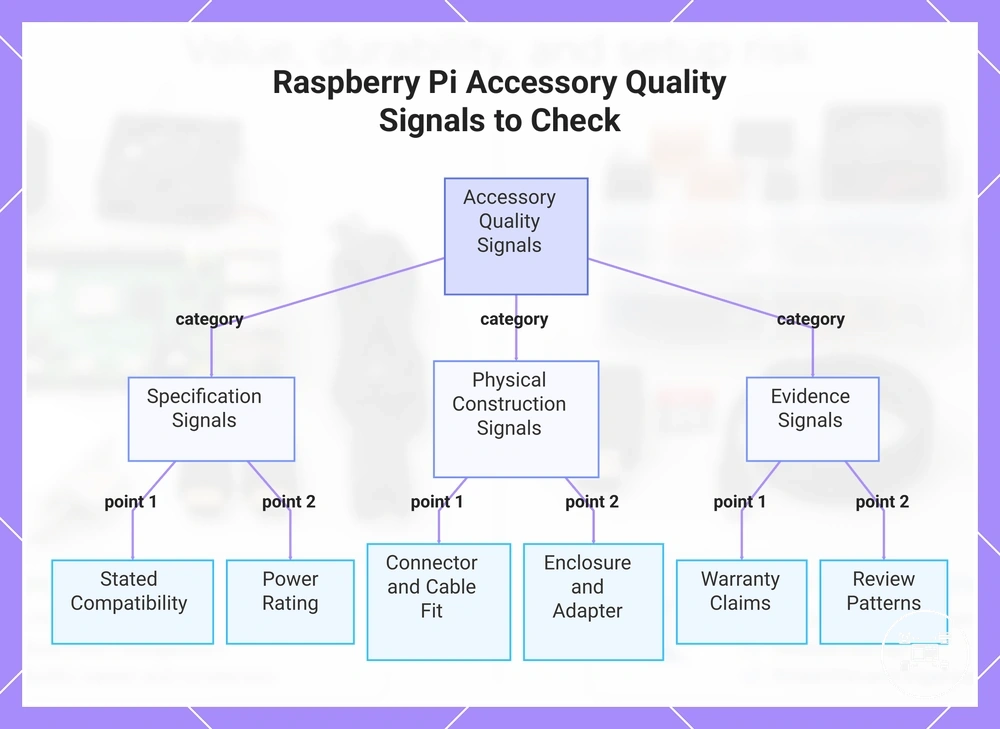
Accessory quality signals should be checked against the exact Raspberry Pi model, setup load, and expected use duration before buying. The required signals are explicit stated compatibility, an adequate power rating, secure connector fit, suitable material and airflow support, durable cable construction, and stable adapter operation. A signal is useful only when it addresses a documented condition of the intended setup rather than relying on appearance, price, or unsupported quality wording. :contentReference[oaicite:0]{index=0}
The checklist below organises each quality signal by the value or condition that should be verified before selection.
The checklist below organises each quality signal by the value or condition that should be verified before selection.
- Stated compatibility: The description should identify the supported Raspberry Pi model, connector, interface, or enclosure format; broad compatibility wording leaves board fit or interface support unconfirmed.
- Power rating: Verify voltage, current, connector type, and peripheral-load conditions. Raspberry Pi specifies 5 V at 5 A, or 25 W, for full Raspberry Pi 5 power capability, while 5 V at 3 A, or 15 W, places a 600 mA limit on available USB peripheral current. :contentReference[oaicite:1]{index=1}
- Connector fit: The connector should insert fully, remain seated during normal movement, and avoid lateral pressure on the Raspberry Pi port.
- Material and airflow support: The enclosure material should provide the required protection while preserving ventilation, GPIO access, and cable clearance; material strength alone does not establish suitable case performance.
- Cable construction: Secure terminations, strain relief, and enough flexibility for the planned route reduce concentrated bend stress near the connector.
- Adapter stability: A storage or interface adapter should state its supported interface and remain mechanically secure during the intended boot or data workload.
Warranty-like claims have selection value only when the responsible provider, coverage period, exclusions, territory, and remedy are stated. Terms such as “lifetime support,” “premium quality,” or “risk-free” do not establish durability when those conditions are absent, so they should be treated as claims requiring verification rather than as reliability evidence.
Warranty-like claims have selection value only when the responsible provider, coverage period, exclusions, territory, and remedy are stated.
Review patterns are more useful when multiple reviews identify the same model, workload, and outcome, such as loose connector fit during movement, blocked port access, fan noise under sustained load, or repeated storage disconnects. Isolated ratings, reviews without a named Raspberry Pi model, and repeated promotional wording provide weaker evidence because they do not connect the accessory condition to an observable result.
No single quality signal proves dependable long-use performance, but agreement across specifications, physical construction, claim terms, and review patterns provides a stronger decision basis.
Use the combined signals in sequence: confirm model and interface compatibility first, then compare the power rating, connector fit, material, airflow support, cable construction, and adapter stability with the planned load and use duration. For example, Raspberry Pi documentation distinguishes Raspberry Pi 5 operation at 5 V 3 A from full-power operation at 5 V 5 A, so a setup with power-demanding USB storage requires a different rating check from a lightly loaded board. No single quality signal proves dependable long-use performance, but agreement across specifications, physical construction, claim terms, and review patterns provides a stronger decision basis. :contentReference[oaicite:2]{index=2}
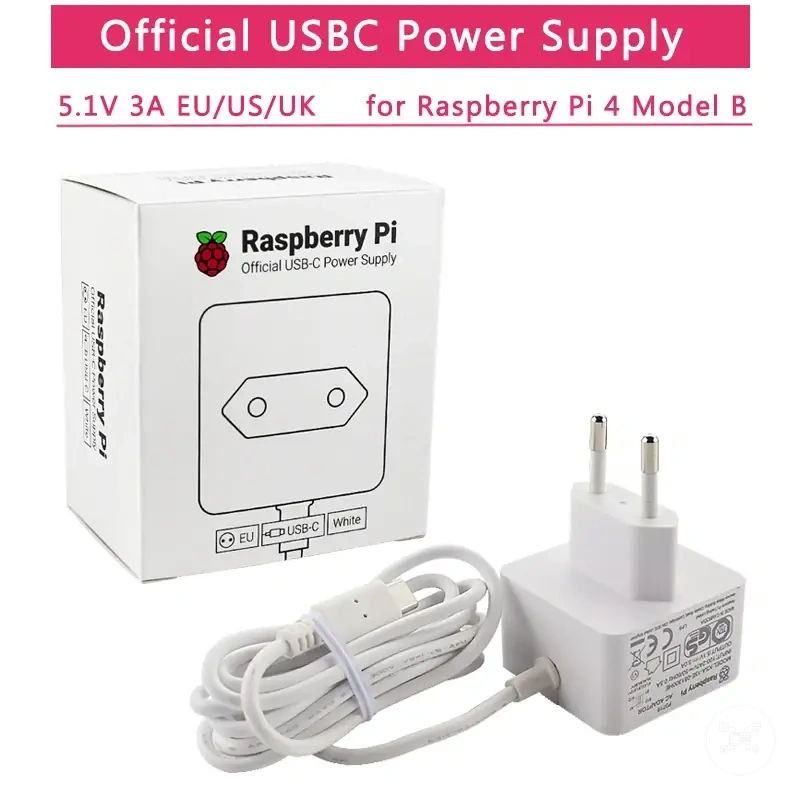
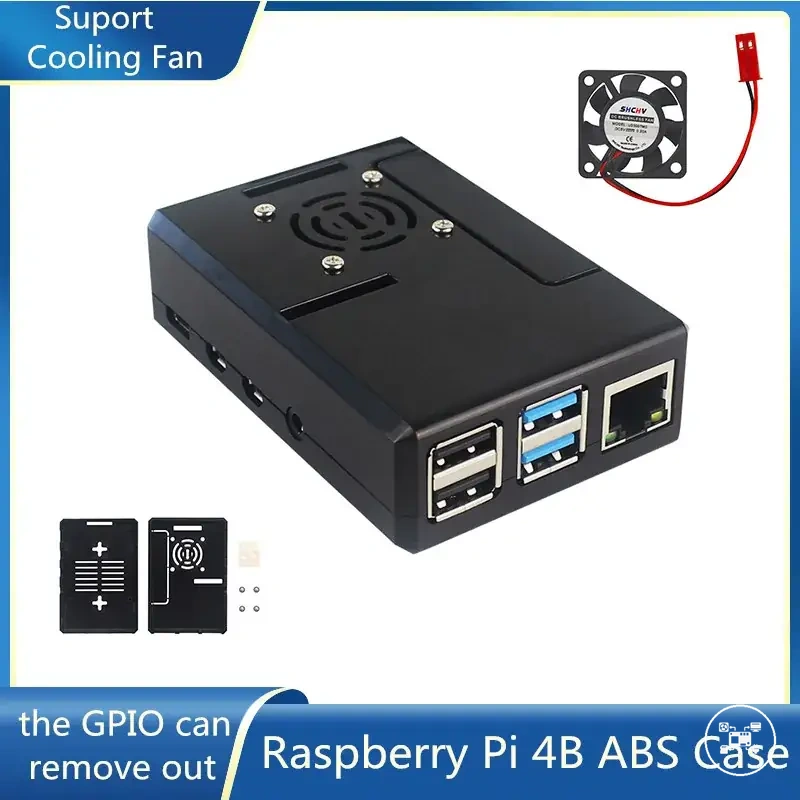
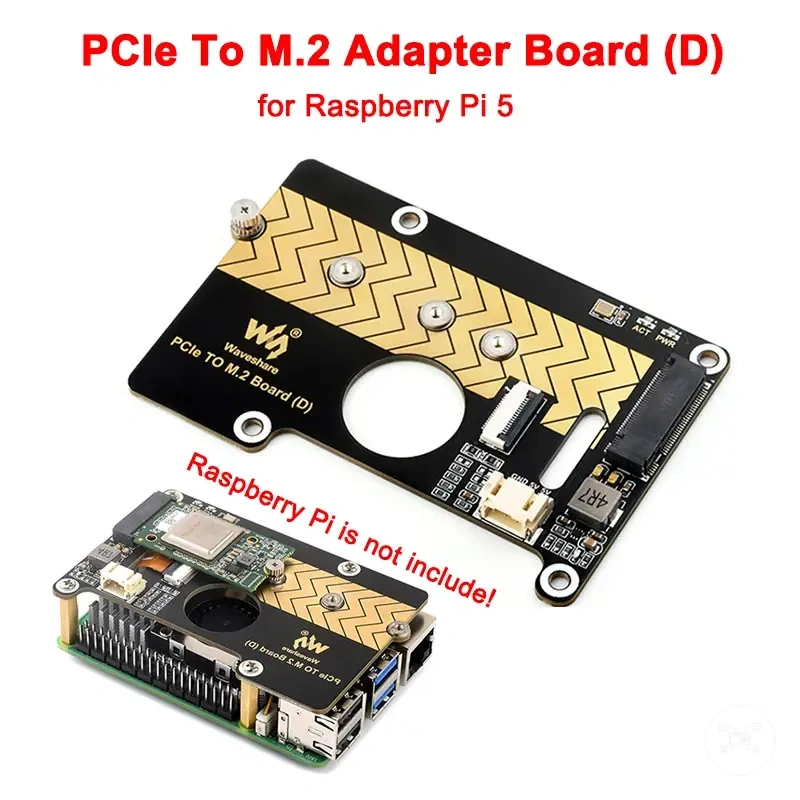
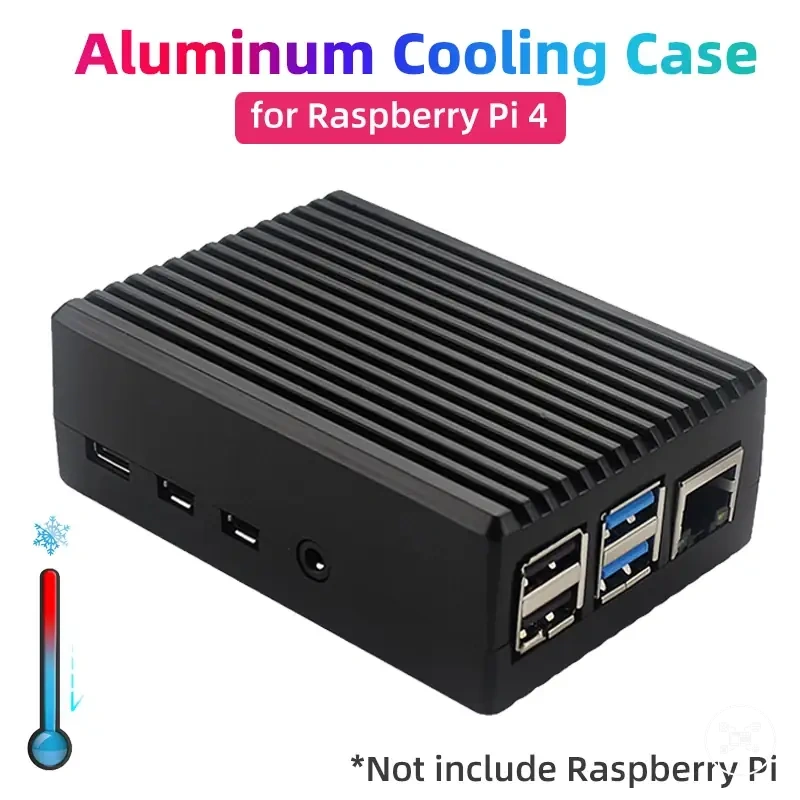
The products below are useful examples for comparing available options.
The products below are useful examples for comparing available options. Before buying, check that the compatibility criteria, key features, and product details match your needs.
This chart shows the key quality signals to verify when selecting Raspberry Pi accessories, organized by specification, physical construction, and supporting evidence.
Official Accessories Versus Third-Party Alternatives
Official accessories usually offer higher compatibility confidence because their stated specifications are tied to a defined Raspberry Pi model, while third-party alternatives can provide suitable build quality, wider availability, or lower cost when their electrical, mechanical, and interface specifications match the same setup conditions. Accessory source alone does not establish build consistency, support expectations, or setup risk. The decision condition is whether the documented compatibility, construction, support terms, and price align with the intended board and workload. :contentReference[oaicite:0]{index=0}
| Accessory source | Strength | Trade-off | When it fits |
|---|---|---|---|
| Official accessories | Model-specific stated compatibility, documented specifications, and a defined manufacturer support path | Price can be higher, while availability and design choice can be narrower | Suitable when compatibility confidence and clear support expectations have greater value than broader choice or lower cost |
| Third-party alternatives | Broader availability, more design options, and potentially lower cost | Compatibility wording, build consistency, and support terms can differ between manufacturers | Suitable when the interface, dimensions, power capability, construction quality, and operating conditions can be verified for the intended setup |
Reliable third-party alternatives can present a comparable setup risk to official accessories when their specifications and real operating conditions align, but that comparison must be made attribute by attribute rather than by source label. An official accessory can also be unsuitable when it targets a different Raspberry Pi generation, connector, load, or enclosure condition, so accessory source should remain a selection signal rather than a certainty signal. :contentReference[oaicite:1]{index=1}
Compatibility Claims Versus Real Setup Conditions
A compatibility claim establishes suitability only when it matches the real setup conditions of the intended Raspberry Pi system. The claim should identify the supported board model and connector, while actual suitability also requires acceptable enclosure fit, power load, thermal condition, workload, and connected-peripheral conditions. The local decision is whether every required setup variable remains supported under the planned operating condition, not whether the accessory carries a broad compatibility label. :contentReference[oaicite:0]{index=0}
A compatibility claim establishes suitability only when it matches the real setup conditions of the intended Raspberry Pi system.
The checklist below separates nominal compatibility from condition-based suitability:
- Board model: The compatibility claim should name the supported Raspberry Pi generation or physical format; support for one board model does not establish fit for another generation.
- Connector: The connector type, orientation, and accessible port must match the board and accessory without requiring an adapter or imposing mechanical strain.
- Enclosure fit: The installed accessory should preserve mounting clearance, port access, cable routing, and ventilation inside the selected case.
- Power load: The board, accessory, and connected peripherals must remain within the power conditions stated for the complete configuration.
- Thermal condition: Cooling and airflow must remain suitable for the actual workload and enclosure rather than for open-bench operation alone.
For example, an accessory can be nominally compatible because its connector and software interface match the board model, yet remain unsuitable when the enclosure blocks the cable path or sustained peripheral use increases the power load and thermal condition beyond the accessory’s stated operating scope. In that case, the compatibility claim remains valid at the interface level, but the real setup conditions do not support dependable long-use operation. :contentReference[oaicite:1]{index=1}
When Paying More Reduces Replacement Risk
A higher accessory price can reduce replacement risk when the added cost improves a relevant condition such as electrical stability, mechanical durability, or physical fit. Extra cost has less reliability value when it pays only for appearance or features that do not affect the intended setup. The decision condition is whether the additional spend removes a documented source of instability, wear, heat, or poor fit in the planned Raspberry Pi system. :contentReference[oaicite:0]{index=0}
Extra cost has less reliability value when it pays only for appearance or features that do not affect the intended setup.
The decision table below organises the setup conditions in which paying more is more likely to change replacement-risk outcomes. Raspberry Pi specifies that Raspberry Pi 5 can use a 5 V, 5 A power supply rated at 25 W for full power capability, while operation with a 5 V, 3 A supply rated at 15 W restricts the power available to connected USB peripherals; this model-specific difference makes correct power capability a relevant value signal for a power-sensitive build. :contentReference[oaicite:1]{index=1}
| Condition | What extra spend changes | Replacement-risk effect | Decision cue |
|---|---|---|---|
| Long-use setup | More durable component construction and secure mechanical assembly | Can reduce wear-related replacement when the accessory operates continuously or is handled repeatedly | Pay more only when construction quality addresses the expected operating duration |
| Power-sensitive build | Voltage, current, connector, and cable capability matched to the board and peripheral load | Can reduce power-related instability and replacement caused by an underspecified supply or cable | Verify the board-specific power requirement and connected load before comparing price |
| Heat-heavy workload | Improved heat transfer, fan consistency, or enclosure airflow | Can reduce sustained thermal stress when the workload and enclosure create continuous heat | Extra cost has clearer value when cooling performance changes under the actual workload |
| Repeated cable movement | Stronger strain relief, connector housing, and cable termination | Can reduce intermittent connections and replacement caused by repeated bending or pulling | Prioritise construction quality when cables are frequently connected, moved, or tightly routed |
| Protective enclosure | More accurate board fit, port clearance, ventilation, and physical protection | Can reduce replacement caused by board movement, connector strain, or restricted airflow | Pay more when the enclosure must protect the board without obstructing access or cooling |
| Storage adapter | More secure connectors, stable interface construction, and suitable thermal design | Can reduce storage disconnects and replacement burden during frequent booting or sustained transfers | Extra cost is more relevant when uninterrupted storage access is important to the setup |
For example, a Raspberry Pi 5 in a long-use setup with power-demanding USB storage has a different replacement-risk profile from a lightly loaded classroom board because the storage workload increases the importance of the supply, cable, connector, and adapter remaining stable together. In that condition, spending more on verified electrical capability and durable construction can provide clearer value than paying for cosmetic features. After the accessory has been selected, maintaining reliable accessories helps preserve the fit, connection quality, airflow, and cable condition that justified the higher cost. :contentReference[oaicite:2]{index=2}
In that condition, spending more on verified electrical capability and durable construction can provide clearer value than paying for cosmetic features.
A cheaper accessory can remain suitable when the setup does not impose continuous load, repeated movement, restricted airflow, or demanding storage activity. A higher price should therefore be treated as a decision signal only when the additional cost changes a specific reliability condition; no reviewed evidence establishes a universal price threshold or exact lifespan at which replacement risk falls for every accessory category. :contentReference[oaicite:3]{index=3}
Before buying, check that the compatibility criteria, key features, and product details match your needs.
The products below are useful examples for comparing available options. Before buying, check that the compatibility criteria, key features, and product details match your needs.
When a Basic Accessory Is Reliable Enough
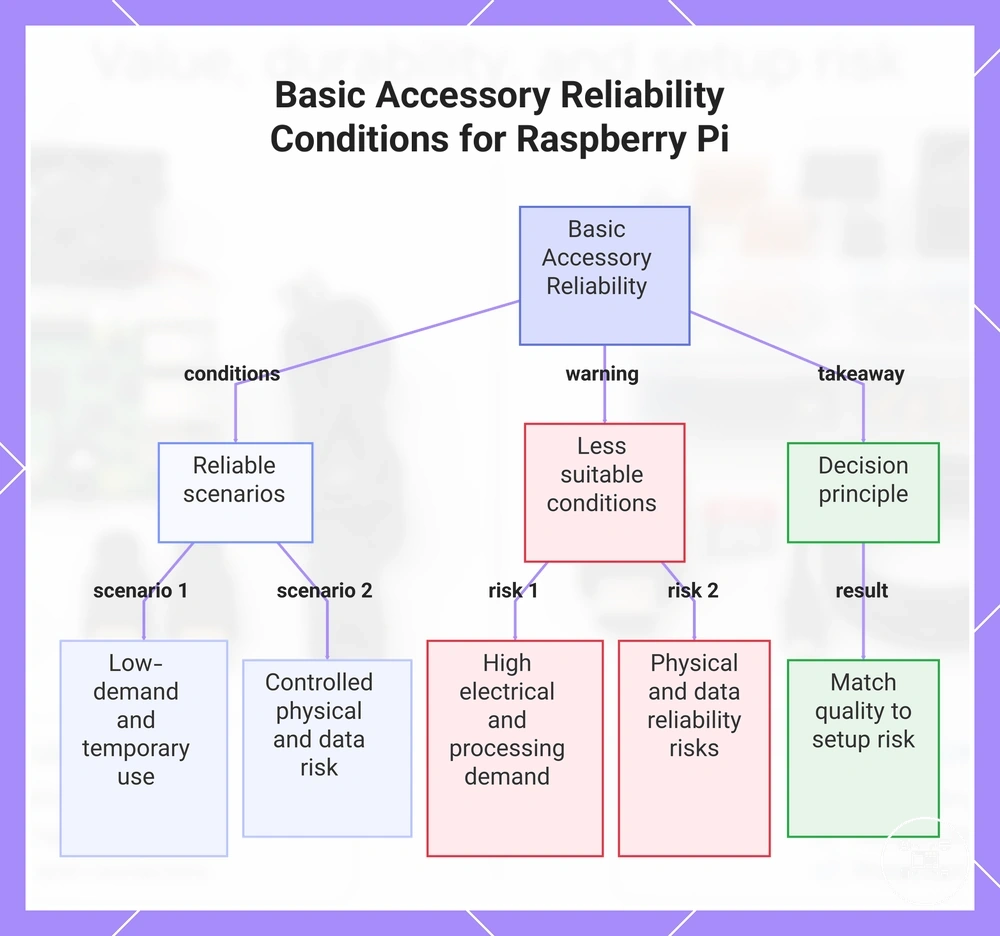
A basic accessory is reliable enough when its fit, electrical or mechanical load, heat, and handling demands remain within the stated conditions for the Raspberry Pi setup. This is most likely in temporary projects, low-load setups, open-air use, systems with minimal peripherals, fixed cables, and non-critical storage tasks. The local decision is whether the accessory meets the actual operating condition without adding avoidable instability, wear, or interruption risk. :contentReference[oaicite:0]{index=0}
The local decision is whether the accessory meets the actual operating condition without adding avoidable instability, wear, or interruption risk.
The checklist below identifies when a basic accessory can be reliable enough without unnecessary overbuying:
- Temporary projects: A basic accessory can be adequate for short tests, demonstrations, or prototypes when interruption has limited practical consequence.
- Low-load setups: Basic power, cooling, and connection accessories can be suitable when the board and attached peripherals remain within the accessory’s stated electrical and operating limits.
- Open-air use: A simple enclosure or passive cooling arrangement can be adequate when airflow remains unobstructed and the board is protected from accidental contact.
- Minimal peripherals: A basic accessory can be sufficient when few connected devices keep combined power, cable, and interface demands within the supported condition.
- Light cable movement: Standard cable construction can be suitable when the cable remains fixed, follows a gradual bend, and is not repeatedly pulled or reconnected.
- Non-critical storage: A basic storage adapter can be adequate for replaceable files, testing, or occasional access when a temporary disconnect would not interrupt an essential service.
A basic accessory becomes less suitable when the setup changes to continuous operation, sustained processing, restricted airflow, repeated handling, multiple power-demanding peripherals, or storage that must remain continuously available. Reliable value therefore means matching accessory quality to real setup risk rather than automatically selecting either the lowest-cost part or the highest-priced option. :contentReference[oaicite:1]{index=1}
This chart identifies when a basic accessory is reliable enough and when it becomes less suitable for a Raspberry Pi setup.
This chart identifies when a basic accessory is reliable enough and when it becomes less suitable for a Raspberry Pi setup.