Raspberry Pi Home Server Accessories for Reliable Server Operation
Raspberry Pi home server accessories support reliable server operation when their power capacity, storage interface, cooling method, enclosure fit, and network connection match the workload and operating duration. A file server, media server, or backup system that operates for 24 hours per day places different demands on these accessories than an intermittently used desktop setup. Reliability therefore means maintaining the required power, data access, temperature control, and connectivity under the server's actual configuration rather than guaranteeing uninterrupted operation.
The accessory requirements begin with the Raspberry Pi model and the number and type of attached devices.
The accessory requirements begin with the Raspberry Pi model and the number and type of attached devices. Raspberry Pi documentation specifies a 5 V, 5 A USB-C input for Raspberry Pi 5, while operation from a 5 V, 3 A supply applies a 600 mA peripheral-current limit; Raspberry Pi identifies its 27 W USB-C Power Supply as suitable when Raspberry Pi 5 powers demanding USB devices such as hard drives or SSDs. Storage capacity must be selected from the server's measured data requirement, while the storage interface, cooling assembly, enclosure, and network connection must remain compatible with the selected board and attached hardware.
This workload-first check gives each accessory a defined requirement and prevents a model-specific power, storage, cooling, enclosure, or connectivity condition from being treated as universally suitable.
For example, a Raspberry Pi 5 home server connected to a USB SSD and operating continuously should be evaluated against the official 5 V, 5 A input specification rather than treated as equivalent to a board with no high-power USB storage. If the same configuration uses a 5 V, 3 A supply, Raspberry Pi documentation limits available peripheral current to 600 mA, so the SSD's documented power requirement must fit within that allowance or receive power through a suitable externally powered connection. This workload-first check gives each accessory a defined requirement and prevents a model-specific power, storage, cooling, enclosure, or connectivity condition from being treated as universally suitable.
Table of Contents
Home server requirements for Raspberry Pi accessory selection
A Raspberry Pi home server requires accessories that match continuous or long-duration server workloads, storage requirements, power demand, thermal conditions, and network connectivity instead of general-purpose Raspberry Pi projects. Within the Raspberry Pi accessories hub, these requirements define the conditions that distinguish home server accessory selection from standard educational or hobby configurations. Accessory suitability is determined by the Raspberry Pi model, connected peripherals, operating duration, and server workload rather than by a single universal accessory specification.
Within the Raspberry Pi accessories hub , these requirements define the conditions that distinguish home server accessory selection from standard educational or hobby configurations.
According to Raspberry Pi Ltd., Raspberry Pi 5 supports full USB peripheral capability when powered by the official 27 W USB-C Power Supply (5 V, 5 A), whereas using a 5 V, 3 A supply limits available USB peripheral current to 600 mA. Home server workloads such as network-attached storage, media streaming, automated backups, home automation, or self-hosted applications frequently operate continuously, so accessory requirements include stable power delivery, storage designed for sustained operation, appropriate cooling, and an enclosure that supports the chosen thermal solution and installed hardware.
The illustration below summarises how workload characteristics determine the required power, storage, cooling, and enclosure accessories for a Raspberry Pi home server.
The illustration below summarises how workload characteristics determine the required power, storage, cooling, and enclosure accessories for a Raspberry Pi home server.
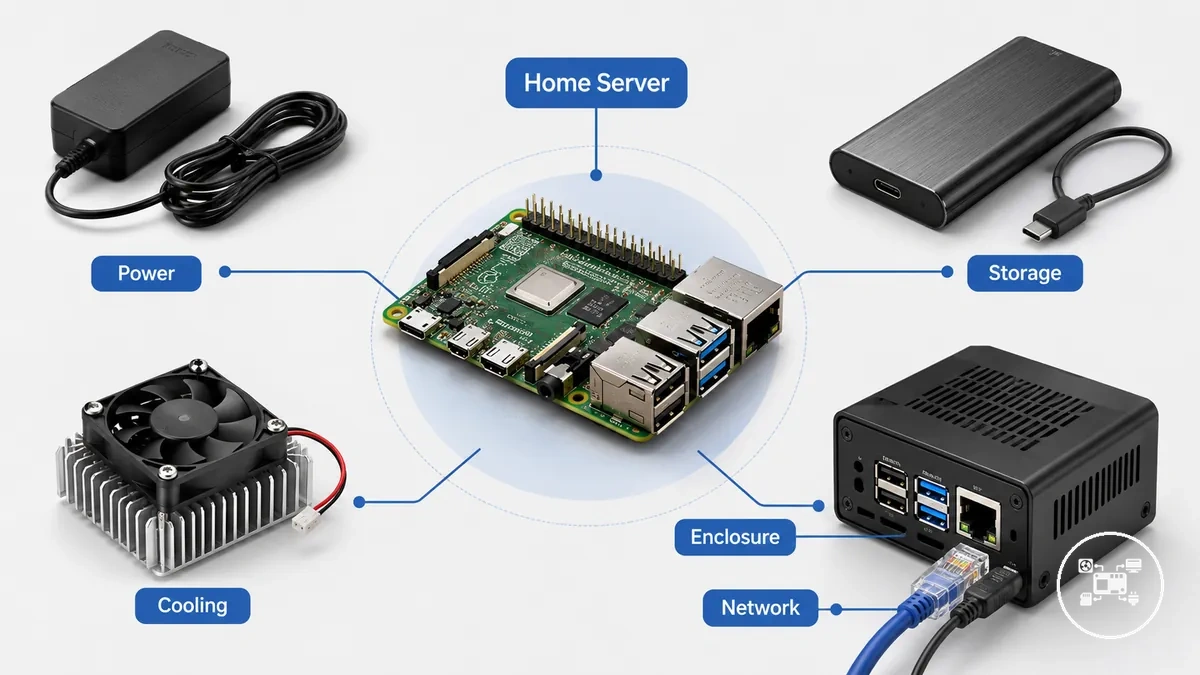
For example, a Raspberry Pi 5 configured as a backup server with a USB SSD, Gigabit Ethernet, and 24-hour operation should be evaluated against the official 5 V, 5 A power specification published by Raspberry Pi Ltd. rather than against the requirements of an idle development board. When the server uses only a 5 V, 3 A power supply, the documented 600 mA USB peripheral current limit becomes part of the accessory selection criteria, influencing whether externally powered storage or lower-power peripherals are required to maintain reliable operation under sustained workloads.
Essential accessory categories for a reliable Raspberry Pi home server
Reliable Raspberry Pi home server operation depends on five accessory categories: storage, power, cooling, enclosure, and connectivity. Each category supports a different operational requirement, and the server's overall reliability is determined by how well these accessories match the Raspberry Pi model, connected peripherals, and continuous workload. According to Raspberry Pi Ltd., stable power delivery, suitable storage, and adequate thermal management are core requirements for sustained Raspberry Pi operation.
Reliable Raspberry Pi home server operation depends on five accessory categories: storage, power, cooling, enclosure, and connectivity.
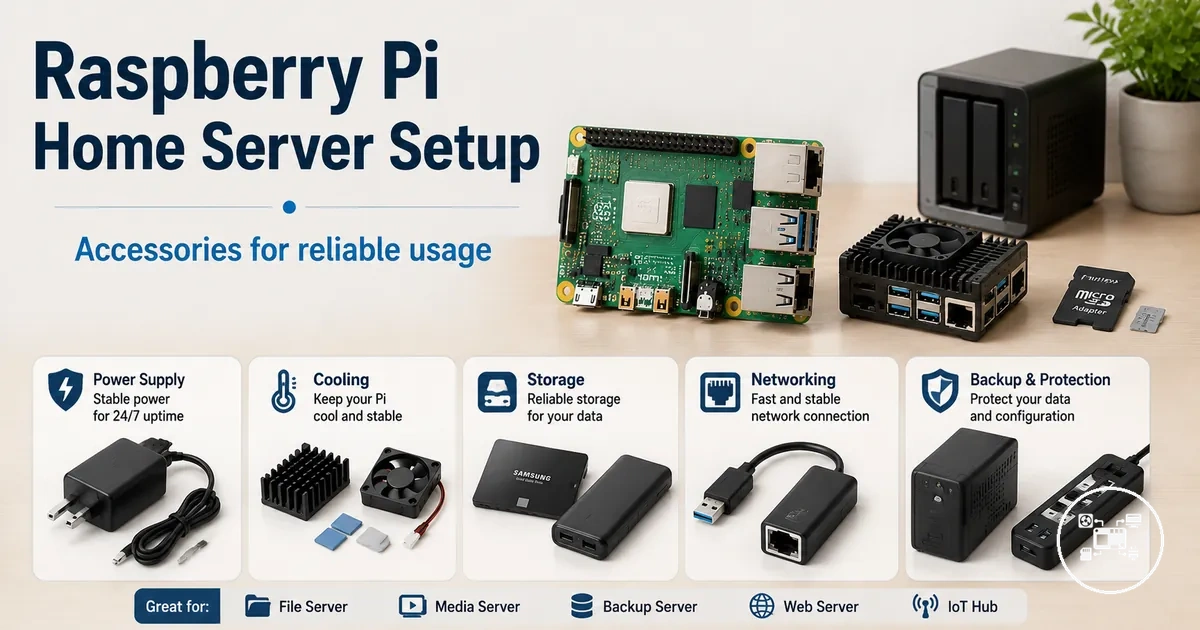
The categories below show how each accessory contributes to reliable home server operation before individual product choices are considered.
- Storage accessories for server use: Storage accessories provide the operating system and persistent data for services such as media libraries, network-attached storage, backups, and home automation. According to Raspberry Pi Ltd., Raspberry Pi 5 supports USB mass storage and PCIe-connected NVMe SSD solutions through compatible hardware, making storage interface selection dependent on the required capacity, speed, and workload.
- Stable power accessories: Power accessories maintain continuous server operation by supplying sufficient voltage and current under sustained load. Raspberry Pi Ltd. specifies the official 27 W USB-C Power Supply (5 V, 5 A) for Raspberry Pi 5 to enable full USB peripheral capability, while operation from a 5 V, 3 A supply limits available USB peripheral current to 600 mA.
- Cooling accessories for long use: Cooling accessories, including heatsinks and active fans, reduce processor temperature during sustained workloads. Raspberry Pi Ltd. states that adequate cooling allows Raspberry Pi 5 to maintain higher sustained performance by reducing thermal throttling during continuous CPU-intensive tasks.
- Enclosure: An enclosure protects the Raspberry Pi while supporting airflow, cable management, and installation of cooling hardware or storage adapters. The appropriate enclosure depends on the Raspberry Pi model, storage configuration, and cooling method used for the server.
- Connectivity: Connectivity accessories include Ethernet cables, network switches, adapters, and related components that connect the server to the local network. Wired Gigabit Ethernet provides consistent bandwidth and lower latency than Wi-Fi for continuous file transfers, backups, and media streaming when a physical network connection is available.
The diagram below organises the relationship between these accessory categories and shows how they collectively support stable Raspberry Pi home server operation rather than functioning as independent upgrades.
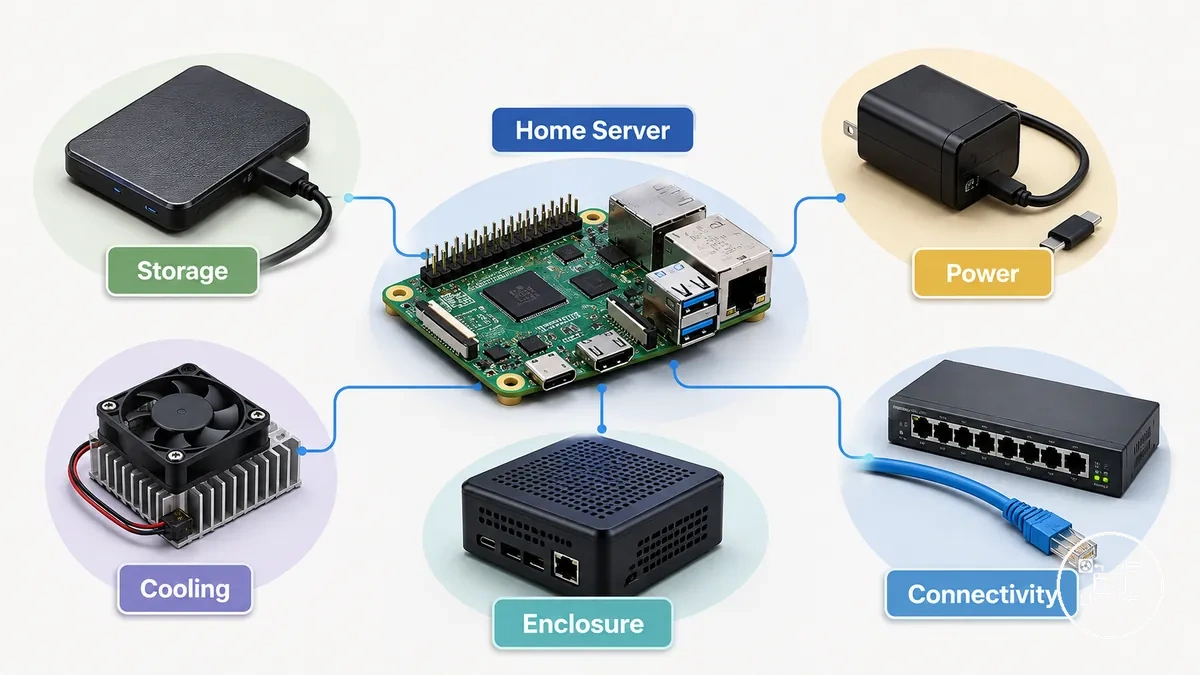
For example, a Raspberry Pi 5 operating as a 24-hour backup and media server with a USB SSD and Gigabit Ethernet benefits from combining SSD storage, the official 27 W (5 V, 5 A) power supply, active cooling, and a ventilated enclosure. According to Raspberry Pi Ltd., this power configuration enables full USB peripheral capability, while appropriate cooling helps sustain processor performance during continuous server workloads.
Storage accessories for Raspberry Pi home server workloads
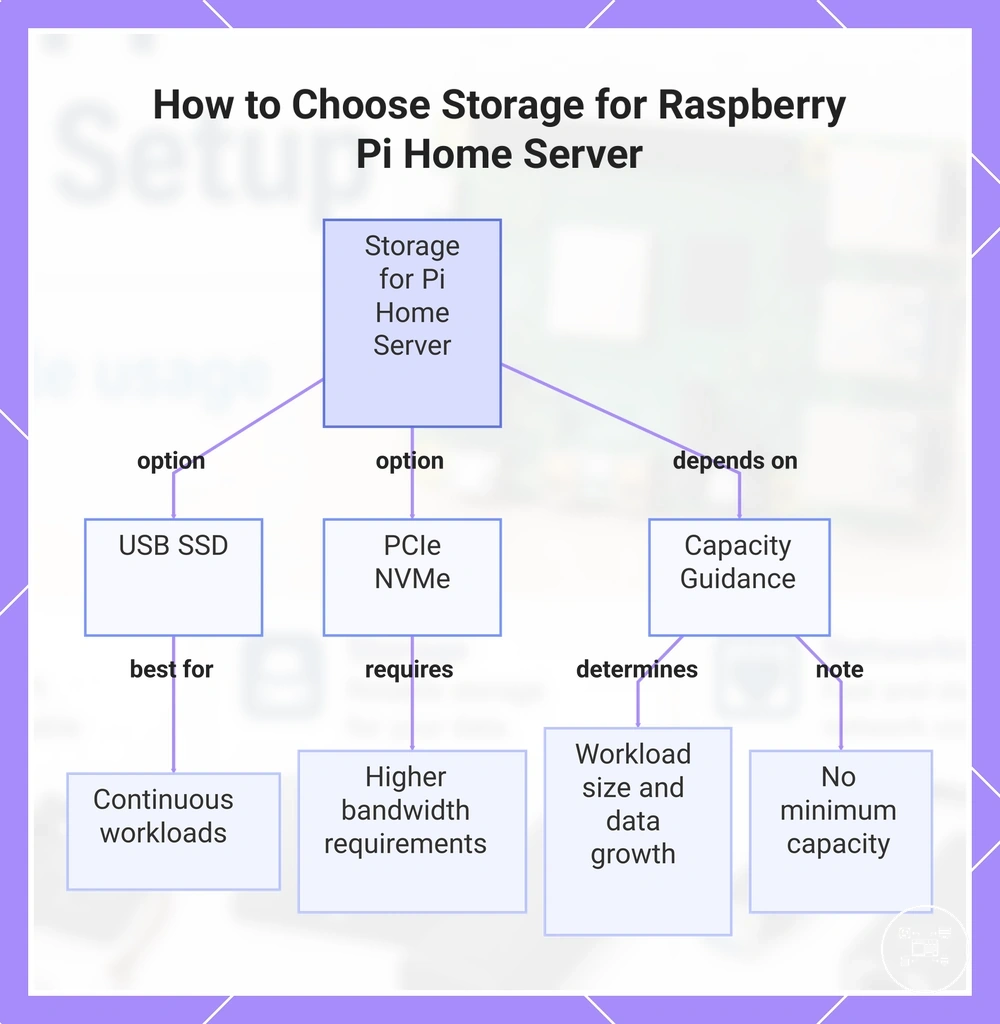
Storage accessories determine how a Raspberry Pi home server stores its operating system, applications, and user data, so storage selection should match the workload, required capacity, and supported interface. According to Raspberry Pi Ltd., Raspberry Pi 5 supports booting from USB mass storage devices and, through its PCIe interface with compatible hardware, supports NVMe SSD storage. Storage capacity has no manufacturer-defined minimum because it depends on the amount of data and the applications the home server is expected to run.
Storage characteristics affect reliability and responsiveness according to workload rather than a universal performance target.
Storage characteristics affect reliability and responsiveness according to workload rather than a universal performance target. USB SSD storage is well suited to continuous workloads such as media streaming, network-attached storage, and automated backups because it provides substantially greater write endurance than microSD cards, while PCIe-connected NVMe SSDs are appropriate when compatible hardware and higher storage bandwidth are required. Raspberry Pi Ltd. identifies both USB and PCIe storage as supported options, with the interface choice determined by the Raspberry Pi model and hardware configuration.
identifies both USB and PCIe storage as supported options, with the interface choice determined by the Raspberry Pi model and hardware configuration.
For example, a home backup server storing 2 TB of photos, videos, and documents should use storage that exceeds the existing 2 TB dataset to accommodate future growth and filesystem overhead. In contrast, a Raspberry Pi running a DNS resolver or home automation platform may require only tens of gigabytes because the application stores relatively little data. The appropriate storage capacity is therefore determined by workload size and expected data growth rather than by the Raspberry Pi board specification.
This chart shows the supported storage interfaces and the key factors for determining storage capacity for a Raspberry Pi home server.
This chart shows the supported storage interfaces and the key factors for determining storage capacity for a Raspberry Pi home server.
Cooling and enclosure considerations for continuous server use
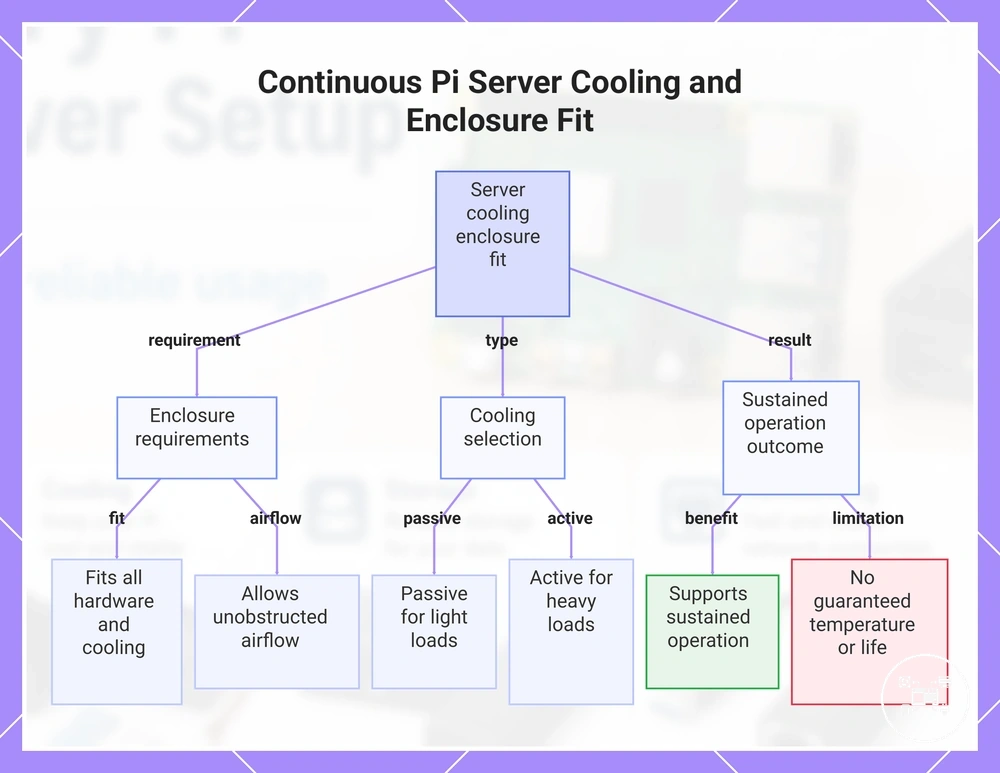
Cooling and enclosure compatibility for continuous Raspberry Pi server use requires the enclosure to fit the selected board, cooling assembly, storage hardware, and cable layout while preserving an unobstructed airflow path. Passive cooling is a conditional choice for lighter sustained workloads, whereas active cooling is the appropriate category when continuous processor or storage activity causes thermal throttling. Raspberry Pi Ltd. identifies its temperature-controlled Case Fan and Active Cooler as Raspberry Pi 5 cooling options for demanding workloads, but the enclosure must provide the mounting clearance and ventilation required by the selected option.
The enclosure affects cooling by controlling how air enters, crosses the heat-producing components, and exits the case.
The enclosure affects cooling by controlling how air enters, crosses the heat-producing components, and exits the case. A ventilated enclosure should not place solid panels, cables, or storage adapters directly against the fan intake, heatsink fins, or exhaust path; a sealed enclosure without another heat-removal method provides no defined airflow route. Raspberry Pi Ltd. specifies that the Raspberry Pi 5 Active Cooler combines an aluminium heatsink with a blower rated for a maximum airflow of 1.09 CFM and a maximum speed of 8,000 RPM ±15%, so an enclosure used with this cooler must leave physical clearance around the assembly and its airflow openings.
The Raspberry Pi 5 Case provides an integrated temperature-controlled fan and a 12 mm × 17 mm × 4 mm heatsink, according to the Raspberry Pi Ltd.
For example, a Raspberry Pi 5 home server operating for 24 hours per day with an NVMe adapter should use an enclosure that accommodates both the adapter and the chosen cooling assembly without blocking ventilation. The Raspberry Pi 5 Case provides an integrated temperature-controlled fan and a 12 mm × 17 mm × 4 mm heatsink, according to the Raspberry Pi Ltd. product brief, while the separate Active Cooler uses a board-mounted heatsink and blower; these are different mechanical configurations and require different clearance checks. Matching the enclosure to the installed cooling and storage hardware supports sustained operation, but it does not establish a guaranteed processor temperature or service life.
This chart outlines the main enclosure requirements, cooling type selection, and the outcome of proper hardware matching for a continuous Raspberry Pi server.
This chart outlines the main enclosure requirements, cooling type selection, and the outcome of proper hardware matching for a continuous Raspberry Pi server.
Power and network accessories for stable home server operation
Power and network accessories contribute to stable Raspberry Pi home server operation when their electrical capacity, interface, and network specifications match the Raspberry Pi model and the server workload. As the primary compatibility criterion, stable power accessories should meet the manufacturer's power specification for the selected board. According to Raspberry Pi Ltd., Raspberry Pi 5 supports full USB peripheral capability when powered by the official 27 W USB-C Power Supply (5 V, 5 A), whereas operation from a 5 V, 3 A supply limits total USB peripheral current to 600 mA, making this threshold relevant when powering external SSDs or other USB devices. :contentReference[oaicite:0]{index=0}
Network accessory compatibility depends on matching the Raspberry Pi Ethernet interface with the connected infrastructure.
Network accessory compatibility depends on matching the Raspberry Pi Ethernet interface with the connected infrastructure. According to Raspberry Pi Ltd., Raspberry Pi 5 includes a Gigabit Ethernet (1000BASE-T) interface, so a Cat5e or higher Ethernet cable connected to a Gigabit-capable router or switch allows the board to establish a 1 Gbit/s wired link when every device in the network path supports the same standard. This compatibility criterion improves stability for sustained file transfers, media streaming, and scheduled backups without expanding into general networking configuration. :contentReference[oaicite:1]{index=1}
This compatibility criterion improves stability for sustained file transfers, media streaming, and scheduled backups without expanding into general networking configuration.
For example, a Raspberry Pi 5 operating continuously as a home backup server with a USB SSD and Gigabit Ethernet should combine the official 27 W (5 V, 5 A) power supply with a Cat5e or Cat6 Ethernet cable and a Gigabit network switch. According to Raspberry Pi Ltd., this configuration provides full USB peripheral capability and supports a wired network link of up to 1 Gbit/s under compatible network conditions, helping maintain consistent storage and connectivity during continuous server workloads. :contentReference[oaicite:2]{index=2}
Choosing Raspberry Pi server accessories based on workload and usage needs
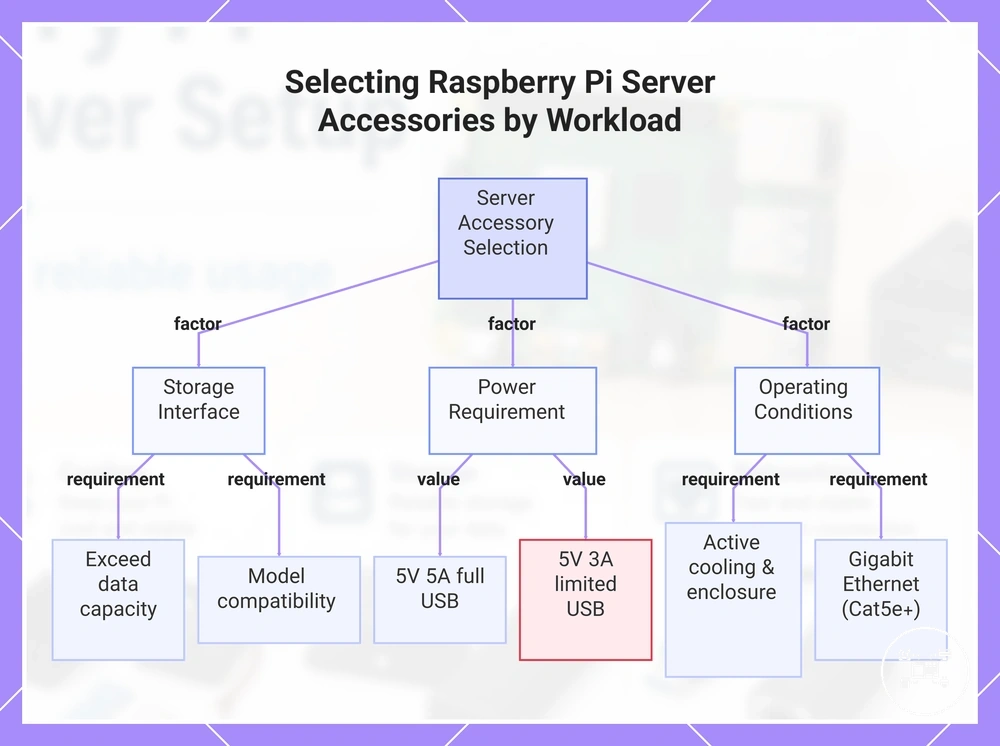
Raspberry Pi server accessories should be selected by matching the workload with storage requirements, peripheral power demand, cooling requirements, network usage, and enclosure compatibility rather than choosing a single universal hardware combination. The correct accessory selection depends on measurable operating conditions such as continuous runtime, storage interface, connected USB devices, and network throughput. According to Raspberry Pi Ltd., Raspberry Pi 5 requires a 5 V, 5 A power input to provide full USB peripheral capability, while operation from a 5 V, 3 A supply limits total USB peripheral current to 600 mA, making workload assessment an essential selection criterion. :contentReference[oaicite:0]{index=0}
The correct accessory selection depends on measurable operating conditions such as continuous runtime, storage interface, connected USB devices, and network throughput.
Select accessories by evaluating compatibility against the workload before comparing individual products:
- Storage: Select a USB SSD or PCIe NVMe SSD that exceeds the required data capacity and is compatible with the Raspberry Pi model and storage adapter. According to Raspberry Pi Ltd., Raspberry Pi 5 supports USB mass storage and PCIe-connected NVMe storage through compatible hardware.
- Power: Match the power supply to the Raspberry Pi model and attached peripherals. Raspberry Pi Ltd. specifies 5 V at 5 A for Raspberry Pi 5 to provide full USB peripheral capability.
- Cooling and enclosure: Select an enclosure that physically accommodates the chosen heatsink, fan, storage adapter, and cables while maintaining unobstructed airflow for sustained operation.
- Network: Match Ethernet accessories to the required network speed. Raspberry Pi 5 includes a 1 Gbit/s (1000BASE-T) Ethernet interface, so a Cat5e or higher cable and Gigabit-capable switch or router are required to establish a Gigabit wired link under compatible network conditions.
For example, project-based accessory selection for a Raspberry Pi 5 operating as a 24-hour backup server with a USB SSD should combine the manufacturer-specified 5 V, 5 A power supply, storage sized beyond the existing dataset, active cooling, a ventilated enclosure, and Gigabit Ethernet equipment. A Raspberry Pi used only for DNS resolution or home automation typically generates substantially less storage activity and USB power demand, allowing a simpler accessory combination while remaining within the documented compatibility limits published by Raspberry Pi Ltd. :contentReference[oaicite:1]{index=1}
This chart shows the main factors for choosing Raspberry Pi server accessories based on workload: storage interface, power requirement, and operating conditions.
This chart shows the main factors for choosing Raspberry Pi server accessories based on workload: storage interface, power requirement, and operating conditions.
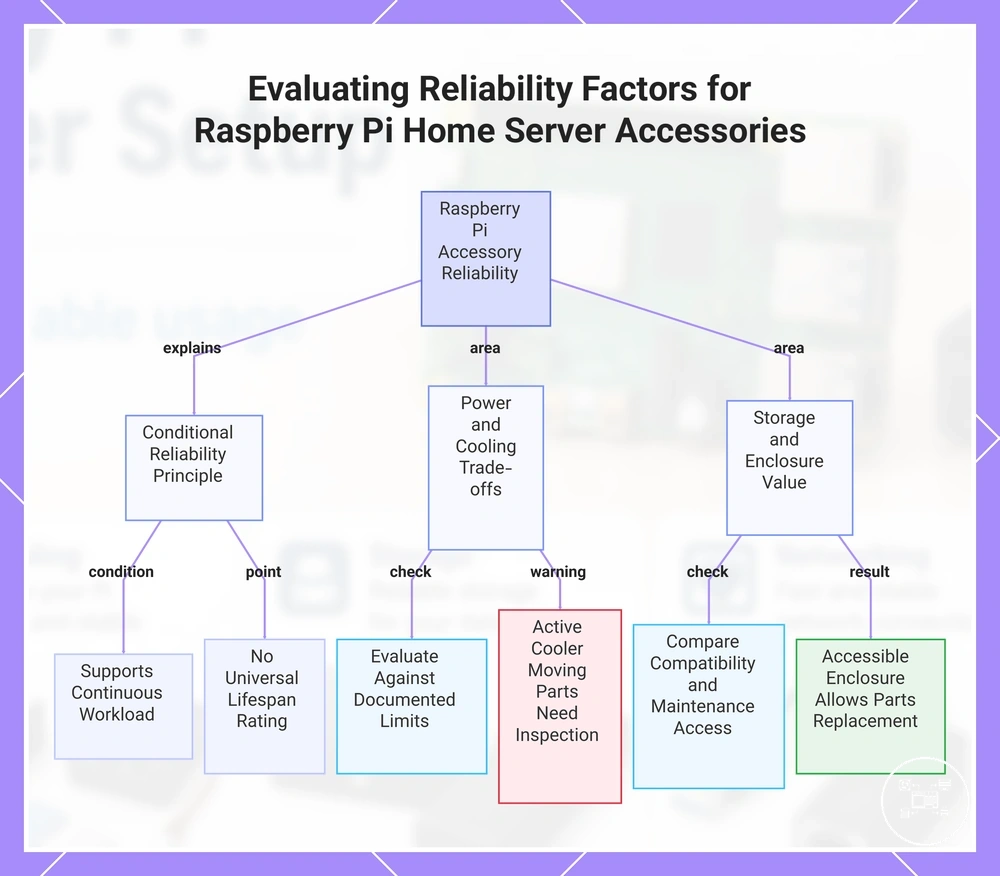
Evaluating reliability factors for Raspberry Pi home server accessories
Raspberry Pi home server accessories provide long-term value when their documented operating limits, maintenance requirements, replaceability, and workload suitability remain appropriate throughout the intended service period. Reliability value is therefore conditional: an accessory is suitable when it supports the required continuous workload without creating recurring power, cooling, storage, or access constraints. A universal accessory lifespan cannot be stated because the reviewed evidence does not provide comparable service-life ratings across power supplies, storage devices, fans, enclosures, cables, and network equipment. :contentReference[oaicite:0]{index=0}
Power and cooling trade-offs should be evaluated against documented limits rather than purchase price alone.
Power and cooling trade-offs should be evaluated against documented limits rather than purchase price alone. Raspberry Pi Ltd. recommends a 5 V, 5 A supply for Raspberry Pi 5; its USB Power Delivery guidance states that a lower-power supply can reduce the power available to attached devices, and high-current SSDs or hard drives may then fail to operate correctly. Raspberry Pi Ltd. also specifies that the Raspberry Pi 5 Active Cooler uses a temperature-controlled blower with a maximum airflow of 1.09 CFM and a maximum speed of 8,000 RPM ±15%, so its long-term value includes active heat removal but also introduces a moving component that should remain accessible for inspection. :contentReference[oaicite:1]{index=1}
Storage and enclosure value should be compared through compatibility, maintenance access, and replacement scope.
Storage and enclosure value should be compared through compatibility, maintenance access, and replacement scope. Raspberry Pi Ltd. states that SSD quality affects the overall Raspberry Pi user experience and documents SSD capacities of 256 GB, 512 GB, and 1 TB for its current range; capacity alone, however, does not establish endurance or suitability for every server workload. An enclosure that permits drive, fan, cable, and power-supply replacement supports long-term accessory maintenance, whereas a tightly integrated arrangement can increase the amount of disassembly required when one serviceable component fails. :contentReference[oaicite:2]{index=2}
For example, a continuously operated home server accumulates a calculated 8,760 operating hours per year , using 24 hours × 365 days .
For example, a continuously operated home server accumulates a calculated 8,760 operating hours per year, using 24 hours × 365 days. An illustrative quarterly inspection schedule produces 4 maintenance checks per year for airflow obstruction, fan operation, cable security, and storage-health indicators; this interval is an example, not a Raspberry Pi Ltd. requirement. Under that usage condition, an accessible enclosure and separately replaceable accessories can provide greater long-term value than a sealed assembly when one component requires maintenance, even if the initial purchase cost is higher.
This chart shows the key factors for evaluating the long-term reliability of Raspberry Pi home server accessories, including conditional reliability, power and cooling trade-offs, and storage and enclosure value.
This chart shows the key factors for evaluating the long-term reliability of Raspberry Pi home server accessories, including conditional reliability, power and cooling trade-offs, and storage and enclosure value.
Common Raspberry Pi home server accessory limitations and considerations
Raspberry Pi home server accessory limitations are configuration-specific: power capacity, interface support, enclosure clearance, cooling compatibility, storage behaviour, and network conditions must match the selected Raspberry Pi model and workload. Published accessory specifications describe operation under stated conditions rather than guaranteed compatibility, throughput, temperature, durability, or service life for every home server setup. The reviewed evidence does not establish one universal performance or reliability value for complete Raspberry Pi home server configurations. :contentReference[oaicite:0]{index=0}
Power and expansion limits require model-specific checks when multiple accessories share board resources.
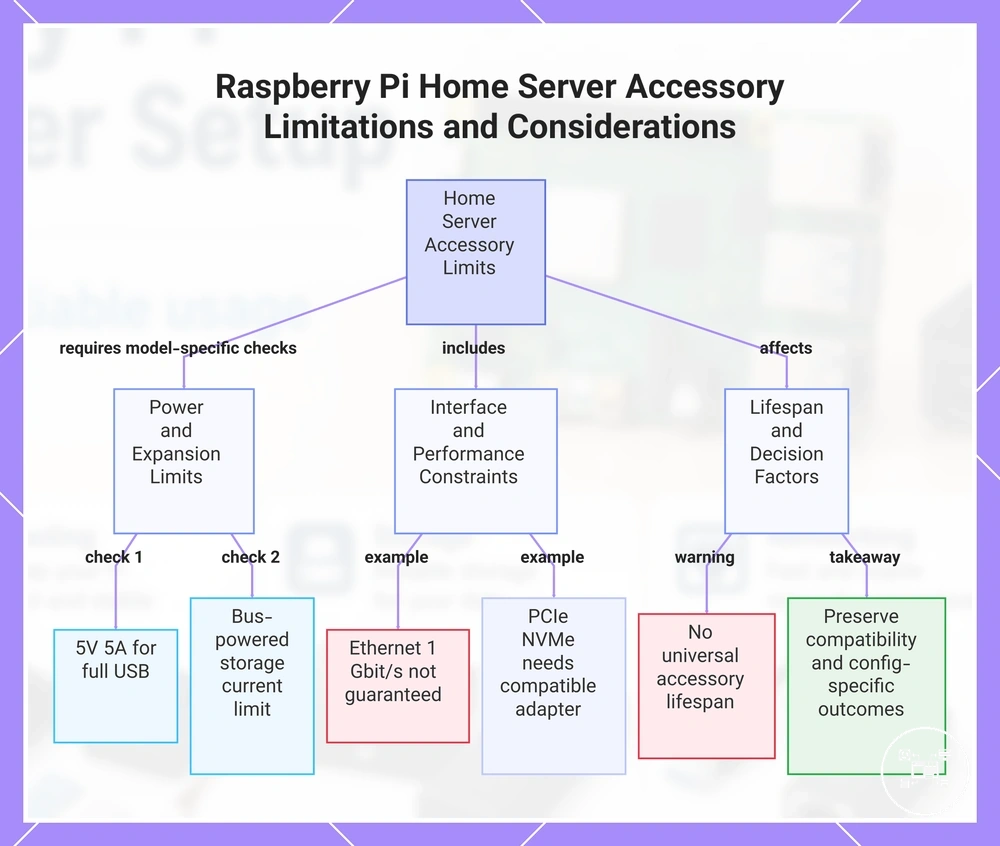
Power and expansion limits require model-specific checks when multiple accessories share board resources. Raspberry Pi Ltd. specifies a 5 V, 5 A input for Raspberry Pi 5 to provide full USB peripheral capability, while operation from a 5 V, 3 A supply limits total USB peripheral current to 600 mA; a bus-powered storage device must remain within the available current or use an appropriate externally powered connection. PCIe-connected NVMe storage also requires compatible adapter hardware, and the enclosure must provide clearance for the adapter, cable, storage device, and selected cooling assembly.
Interface ratings do not guarantee application-level performance.
Interface ratings do not guarantee application-level performance. Raspberry Pi Ltd. specifies a 1 Gbit/s Gigabit Ethernet interface for Raspberry Pi 5, but actual file-transfer performance is constrained by the storage device, protocol overhead, switch, cable, client device, and concurrent workload. A server operating continuously for 24 hours per day also has no manufacturer-defined universal accessory lifespan, so final decisions should preserve documented electrical and mechanical compatibility while treating throughput, temperature, noise, maintenance frequency, and service life as configuration-specific outcomes.
This chart shows the key limitations and considerations for Raspberry Pi home server accessories, including power and expansion limits, interface performance constraints, and long-term decision factors.
This chart shows the key limitations and considerations for Raspberry Pi home server accessories, including power and expansion limits, interface performance constraints, and long-term decision factors.